Showing posts with label tamil diaspora. media. Show all posts

Monday, September 24, 2018

ARINGNAR ANNA ON BHARATHIAR


People’s poet:

ARINGNAR ANNA ON BHARATHIAR

[Anna taught us to respect men of eminence from opposing streams of thought, and having been groomed by such noble leader, we see the greatness of Bharathiar though he flip flopped between Tamil and Sanskrit….. N.N]

Charming and significant as the term is, it is a warm tribute not only to the poet but also to the people for the people had had their monarchs and ministers, their warriors and saviors, their seers and saints, miracle - mongers and priests, but had no poets and from ages past there were poets in abundance, poets who supplemented the scriptures or who polished the palaces by their poetry, but poets who sang for and about the people in the people’s tongue were very rare.

The poets’ voice did the function of the temple bell or the palace drum but rarely did that voice represent the innermost thoughts of the people and when at times poets spoke about the people, it was to point out to them how greedy and worldly they have become, how impermanent and illusory this world is, how sinful is silver and how ungodly is gold, and such like sermons that supplemented the royal rod and the whip of the aristocrat. Poets became in due course one more important item in the Royal paraphernalia, one more policeman who filed the case here and asked the high heavens to deliver the judgment later on.

These poets spoke in a different tongue altogether and were far from the people. They despised the crowd from where they rose and used their poetic genius to gain admission to the royal palace, and when once there, they went on weaving wordy wreathes for monarchs of all sorts, provided his gold was pure. The poets of the Sangam period are noble exceptions to this sorry rule and they are the poets least known to the people of our days.

Poets either became vendors of virtue in verses or became pleasure merchants, and they found it hard and unprofitable to become the People’s Poets. That is the reason why we find no outstanding people’s poet after the Sangam Age in Tamil Nadu.

Virtue itself came to be considered an investment for a happy life in another world. Hence, poets who came after the advent of this false and pernicious theory began to extol the particular bank of dispensation for which they were the self appointed agents. Like the clever banker, or the active insurance agent, these poets began to pour forth rhymes in abundance, about the soundness of their Bank, about the delightful dividends and the bright prospects. If one poet gave the people a sweet song about the powers of Garuda of Maha Vishnu, up raised another to supply us with a sacred sonnet about the stately bull of Siva, or the beautiful peacock of Muruga or even the ugly buffalo of the all powerful god of death, Yama.

All these poems were of the highest order, looked at from the artist’s point of view. There was rhythm, diction, similes, metaphors, parables all in abundance except reason. These poets thought that the temple bell did not work well and thought it their duty to lend their poetic strength to supplement the sound duty or no duty, it was such a paying job that there was a rush in that direction. Poets assumed an attitude of superiority they enjoyed the common men’s confusion, they tried to compromise contradictions and beautify absurdities, they were loud in their denunciation of things worldly; the worthlessness of human life, the littleness of mankind and they presented a poetic picture of the unknown world heaven up above the clouds, and the hell underneath the earth.

The telescope was in the womb of science. Hence, heaven existed, and the poets entertained the people with imaginary descriptions about the theological worlds! The ignorant stood amazed and the intelligent adored the art and not the thought.

Role of a People’s Poet

It is not easy to take up the role of a people’s poet. Bharati rose equal to this stupendous task. It is easy to become the poet of the classes. Some sweet sonnets about the silvery moon swimming in a sea of blue. some poems about  the twinkle of the stars, fine poems about the fragrance of the flower, the rhythm in rivers, lyrics about the love and verses about valour, these are enough to secure a place of honour in the poet’s gallery. But to discharge the duties of a people’s poet, one has to cross hurdles of hatred, take many a dive into dangers and should not think about patronage and popularity. Though a select circle of friends knew and spoke about the poetic genius of Subramania Bharati, the people as a whole were almost unaware of their poet till at a later stage, and then too it was the poems of a political colour that was presented to the people, and not the poems which a people’s poet alone can conceive and deliver.

We had poets in abundance. The shepherd sleeping inside a temple forgetful of his home and vocation, the goddess returning after her midnight supervision, the smile on her lips on seeing the simpleton, her curious idea to make him a poet, the gentle pat and the touch of the divine rod, the wonderful results these were known to the people. One becomes a poet, because of the divine touch, and it is his duty to sing devotional songs to a particular deity or to all. This theory held the ground so strongly that the people were not prepared to meet the people’s poet, even when one came forward. The people will cast a look of contempt and suspicion on one who says boldly. “I am the people’s poet. I sing for them and about them because I am one of them”. There would be no recognition and the more radical his poems are, the more vehement will be the opposition. And in this dangerous ground, we find Subramania Bharati, taking steady steps victoriously.

The State of Affairs when the Poet was born

Bharati was born on the frontier of two eras; the feudal order was in full force in his homeland. Ettayapuram had a palace surrounded by huts. Age old castes were still in power. He himself was a Brahmin by birth but side by side with feudalism and Sanathanic order of Society, modernism was peeping in. Industrial revolution was dawning, the old order met the new with sorrowful eyes, and there was a challenge in the look of the new era. Bharati was born during that period and none could have imagined that he will become the warrior in the duel between the old order and the new; for in the old order of things his was a comfortable place.

He was born, moreover, in this land of paradoxes, a land where arrogance and humility, cruelty and kindness march together, where there is energy in abundance and absurd contemplation strong enough to dissipate the energy, a land of some dazzling ideas and millions of mute people, a land where there is apoplexy at the center and anemia at the extremes, the land of courage as well as fear, the land of faith as well as despair. Byron and Burke landed here just then, only to meet Bharatam and Bagavatham. The booming of the gun became familiar to the ears of the people and the age long temple drum was not silent in such a land of paradoxes and perplexities.

Bharati was born, and in such a land history moves but slowly and it needs a strong push if it should move at all. Bharati’s claim to greatness rests chiefly on this: he gave the push as the people’s poet.

Morning Star of Reformation

Bharati was not merely the bard of Nationalism. He was certainly the morning star of reformation only because he was the people’s poet. He was angry with the foreigner, and wanted his country to become free but that was not his goal that was not to be his end. It was but the beginning. He wanted to free his country men from all shackles, wanted them to rise up in the estimation of the world, wanted to see a new land peopled by men and women of a new type altogether. He found the people enveloped in fear. Fear was written on their very faces.

They were afraid of anything and everything. Not only did they fear the foreigner and his gun but their own brethren chanting some slogans. They were afraid of ghosts and phantoms.

Eradication of Superstition

Such a people cannot become the standard bearers of freedom and a land peopled by such nature cannot lift its head high, and look straight at the world, even if the foreign power is driven out. Hence Bharati wanted his countrymen, to drive out fear from their mind to shed off inferiority complex. He instilled into their minds hope and courage, he placed before them their own hidden powers and pointed out to them, how that innate power is being wasted, the slumber of the masses, their gross ignorance, and superstition, their inferiority complex and their caste prejudices. Bharathi saw clearly and he determined to root out these evils and none but a people’s poet could have been so deeply interested in these problems.

World Freedom Movements and India

But Bharati knew fully well, that it was the age of the common man, the era of democracy and he wanted the people to fight for freedom. He did not deliver mere devotional hymns to the divinities nor did he send poetic appeals to the princes of the land. He addressed the man with the plough, the woman at the cradle and even the children at the play grounds. He did not, like the poets of a bygone age, point out ancient scripts in support of freedom, but placed before the masses, the world events of importance, and the freedom movements of distant lands. He announced to the people, the dawn of freedom in Italy through the marvelous resurrection of the masses, thanks to Mazzini the patriot.

He painted in glowing colours, the picture of France after the revolution, and placed a brand new picture about Russia, free from the shackles of Czardom, free Belgium, free France, Red Russia these were the pictures that he placed not the theological land of Indra or Brahma and having placed these pictures, he also presented them with a pen picture of country men at Fiji islands, and like Shakespeare he asked, “Look at this picture and at that!” That is the people’s poet. One who is not afraid of pointing out the follies and foibles of his own people, one who is not afraid of showing to his own people, how slow they are in thought and action whereas peoples of other lands were moving fast and faster to a nobler sphere of activity and life. He was not afraid of the privileged class, and did not falter to place the full facts before the people.

Projecting a new vision altogether

As the People’s poet it was his duty to unmask cant and hypocrisy wherever it was to be found, and he did that with remarkable courage and enthusiasm.

There is an attempt by interested parties to enlarge the portrait of Bharati, the national bard, not entirely because they love that portrait but because they think that portrait’s immensity will conceal from the public eye, the other portrait, the portrait of Bharati, the people’s poet.

Bharati’s poems are no mere hornets. The people’s poet was not afraid to lay bare the absurdities of ancient systems and thoughts, and in almost infuriated tone, he asks those who champion the cause of conservatism in very strong words, “Fools! Do you argue, that things ancient ought, on that account, to be true and noble! Fallacies and Falsehoods there were from time immemorial, and dare you argue that because these are ancient these should prevail?”

“In ancient times, do you think that there was not the ignorant, and the shallow minded? And why after all should you embrace so fondly a carcass of dead thoughts. Live in the present and shape the future, do not be casting lingering looks to the distant past for the past has passed away, never again to return, “so says Bharati and therein we meet.

He gave a moral code for the masses, not unrelated to life, as some of the ancient codes, were. He boldly differed from the ancient codes and placed before the people, a new vision altogether. He refused to allow the thought of Maya philosophy to have a hold on the people. He ridiculed that theory strongly and infuriated the Ashramites, but he was not afraid of the consequences. “A people immersed in such a thought,” Bharati said, “will become inactive, unprogressive and such a people will become worthless”.

Service to Humanity

Hunger and poverty and ignorance, he will not tolerate, and he raises his powerful voice against the tyranny of the rich, and threatens the whole world with dire consequences even if a single individual is made to starve. He wants the people to lead a full life, develop their faculties, improve their commerce, industrialize their land and enjoy all the benefits of the new era. His religion is not to be priest craft and slogan shouting: his religion is service to humanity and brotherhood in the broadest sense.

The Task of the people’s Poet

The task that lies before the people’s poet is a mighty one. It is his task to make the people realize new truth, take a new path, and get a new process of valuation altogether. It is his task to release the people from the clutches of the Astrologer, and place before them the Astronomer. His is the task to drive out the Alchemist from the people’s mind so that the chemist can come in. His is the task to push aside the priest so that the teacher can get a place.

The people’s poet has the mighty task of driving out the influence of the Miracle monger so that the Medical man can find a place in the order of things. Superstition is to be fought out so that science can flourish. In short, the people’s poet has the task of a revolutionary and more difficult than that of the revolutionary for the people are apt to mistake the tyrant for the saviour and the saviour for the tyrant.

He fought with courage and though the battle is not over yet, and though he is no more alive he has given an armoury of thought enough for the successful termination of the fight and the best and lasting tributes that one can pay to this people’s poet, is to continue the fight, the fight for freedom of the people, in its fullest and noblest sense. And there are men for the job and it will be finished.

Saturday, September 22, 2018

CULTURAL STRUGGLES of DRAVIDA PERAVAI

CULTURAL STRUGGLES

1.Dravida Peravai Youth Wing conference presided by N.J.Karthikeyan Youth Wing Secretary urged the Union Government to declare THIRUKURAL AS NATIONAL BOOK OF INDIA(31.3.1996)

2.Dravida Peravai campaigned to protect ARIKKAMEDU THE archaeological site near Pondicherry, the only site in peninsular India proven archaeologically datewise(3.8.96 Dinamalar, THE HINDU etc) Archaeology : 

SAVE ARIKAMEDU CAMPAIGN PLANNED

Pondicherry, Aug. 1, 1996. An appeal has been made to the Archaeological Survey of India (ASI) by the Dravida Peravai in Pondicherry to acquire the Arikamedu site and fence it so that the historically and archaeologically important finds here could be displayed for the benefit of scholars, tourists and researchers. A campaign to "Save Arikamedu" would be launched by the Peravai, according to its leader Mr.Nandhivarman. - Our Staff Reporter. THE HINDU. 

DRAVIDA PERAVAI APPEAL TO THE ARCHAEOLOGICAL SURVEY OF INDIA

Let me recall the article written by Mr.R.E.M.Wheeler, Mr.A.Ghosh and Mr.Krishna Deva titled Arikamedu: An Indo-Roman Trading Station on the East Coast of India Published in Ancient India Bulletin of the Archaeological Survey of India of July 1946. Fifty years have been swept away by the tides of time, but your department has failed to acquire the valuable site and properly fence the area to preserve the treasure trove of archaeological importance. As a result now the land mafias have set their eyes on the site. Let me quote few lines "Arikamedu, the special importance of which in South Indian archaeology has been stressed on P.1 of this number, represents the site of a considerable buried town on the Coramandel coast". "The special value of the site lies in the fact that in addition to being an Indian town and port, it was also a centre of trade with the Graeco-Roman world and the relics recovered from it include pottery and other objects of Indian culture is thus dated with precision, and thereby achieves the distinction of being the first ancient Indian culture to be dated archaeologically in the Indian peninsula". A buried town - a site where first ancient Indian culture is dated archaeologically and discovered 50 years back just has a warning board that it is a protected monument. Without acquiring the site, fencing it prioperly and creating a museum in the site to display the findings which will be of interest to tourists and archaeologists from world over, your department has neglected all these years. Now we are launching a Save Arikamedu campaign, and we urge your department to speed up the matter, before everything is lost by landgrab. - N.NANDHIVARMAN, GENERAL SECRETARY, DRAVIDA PERAVAI. 

DRAVIDA PERAVAI APPEAL TO THE UNION MINISTER FOR HUMAN RESOURCE DEVELOPMENT HON'BLE S.R.BOMMAI.

The excavations by Jouvean Dubreuil in 1937 at Arikkamedu revealed hitherto unknown facts about the grandeur of the Dravidian Civilisation. It is a matter of regret that his discoveries are now in the French School of Museum at Hanoi. The British Director General of Archaeology M.Wheeler excavated many things at Arikamedu which are lodged at the Archaeological Survey of India. Dravida Peravai with anguish points out that only fragments of the bulk of archaeological discoveries are at the Roman Rolland Museum, Pondicherry. Dravida Peravai urges the Union Ministry of Human Resource Development to bring back all the discoveries lodged at Hanoi and New Delhi to Pondicherry. The Romain Rolland Museum must be constructed at a new site for which necessary central financial aid should be forth coming. At the new museum steps must be taken to keep all the Arikamedu discoveries under one roof. "Poduke" the ancient port city (Pondicherry) received 120 vessels from Red Sea ports according to Strabo. Wheeler discovered the remnants of a factory owned by Romans belonging to the reign of Augustus. Textile exports especially muslin cloth from Arikamedu area stands archaeologically proven by the discovery of series of tanks or dyeing vats. Graeco-Roman gem cutters habituated that are and had left gems carved with intaglio design as proof. Chinese ports of the 10th and 11th centuries had trade links. "The special value of Arikamedu site lies in the fact that in addition to being an Indian town and port, it was also a centre of trade with the "Graeco-Roman world and the relics discovered from it include pottery and other objects of known origin and date from the much studied Mediterranean area. The associated Dravidian culture is thus dated with precision, and thereby archieves the distinction of the being the first ancient Indian culture to be dated archaeologically in the Indian Peninsula" say the Bulletin of Archaeological Survey of India dated July, 1946. Inspite of such early discovery, the usual neglect that goes with the erstwhile rulers towards Dravidian culture and civilisation is responsible for the failure of the Archaeological Survey of India to acquire the site, to fence it and to continue the excavation deeper. Harappa-Mohanjadero, the citadels of Dravidian Civilisation now remains confined in Pakistani territory, and the Arikamedu which remain within Indian territory faces continued neglect. Dravida Peravai urges your ministry to initiate suitable steps to acquire the area and seek UNESCO aid to preserve the archaeological treasure trove of Dravidian Civilisation. - N.NANDHIVARMAN, General Secretary, Dravida Peravai. 

ARIKAMEDU CONTACTS WITH RED SEA PORTS

(Mr.P.Ravichandran from Muthialpet, Pondicherry having done M.Phil in Archaeology from Madras University, participated in the Arikamedu excavations conducted jointly by an American team headed by Dr.Vimala Begley and the University of Madras during the three seasons from 1989 to 1992. He has now returned to Pondicherry from Egypt where he was Trench Supervisor at excavations cibdycted at Abu Sha'ar' by an international team of archaeologists headed by Prof.Stevens Sidebothams of Delaware University, USA. His report citing evidences of Arikamedu's possible links with the Red Sea Ports is given below.) Excavations at Arikamedu, a little south of Pondicherry city have thrown up considerable evidences of Indo-Roman trade particularly from the ports of ancient THAMILAKAM . This trade was carried on for many centuries through the Red Sea Ports from where the goods were carried overland to the Mediterranean ports of the early Roman Empire. Besides luxury items, common trade goods of all types were carried from Arikamedu and many other partly investigated port sites from Southern India, through tge Egyptian Red Sea ports. These emporia were from north to south along the 800 k.m. long stretch of the Red Sea coast, ie Clysma-Qolzoum-Cleopatris (near modern Suez), Myos Hormos, Philoteras, Leukos Limen (Quseir al Qudium), Nechesia and Berenice. The goods which were transported from Arikamedu and other centers arrived in these parts and were then shipped to other Nile destinations and from thereto Alexandria for further transhipment to other Meditera- nian ports. Exports from Roman ports via Egypt to other Red Sea and Indian Ocean destinations took the same route in reverse. Three major overland routes connected the Red Sea ports with the emporia along the Nile including Apollonopolis Magna (Edfu), Coptos(Qift), Kainopolis and Tentyris(Denderah). The northern overland route started from Abu Sha'ar' (Myos Hormos?) the central route from Leukos Limen and the southern route from Berenice. Berenice, the largest and southern most Egyptian emporium required less effort to reach the Nile which is approximately only 260 k.m. away. The northern route from Abu Sha'ar' (Myos Hormos) included traffic from quarries at Mons Porphyrites and Mons Cloudianus, about 190k.m. away from the Nile. The shortest overland route was the central one from Leukos Limen approximately 175k.m. away. It passed through Fawakhir. Strabo speaks of 120 ships sailing for India from Myos Hormos on the Red Sea. I have had a chance to join in the excavations at Myos Hormos, directed by Prof. Steven E.Sidebotham of Delaware University, during the summers of 1991 and 1992. I took my flight to Egypt sgyrt my second excavation of Arikamedu in Pondicherry. The Myos Hormos site had been identified as a Red Sea Port by archaeologists earlier. Investigations in 1991 and 1992 however revealed that Myos Hormos was not merely a commercial port, but rather a late Roman/Byzantine 'fort' and therefore we named it as Abu Sha'ar'. The real Myos Hormos may have been probably some where else in the vicinity. However our investigations of this fort and its surroundings demonstrated that it was founded, used and apparently peacefully abandoned between the fourth and seventh century A.D. There is no evidence whatsoever of later Islamic occupation. One more season (1993) of excavation is planned there. We know that there was a revival of the Read Sea-Indian trade when the 'fort' came to be established at Abu Sha'ar'. The caravan tracks here are indirect evidences of this trade renaissance. The second overland route started from Leukos Limen port which was, of all the Roman Red Sea ports in Egypt, the closest to the Nile. There are eight fortified stations and 65 watch towes all along the route. Many of these stations contain wells or cisterns to supply potable water for the desert travellers, traders and their animals. These stations were constructed purely for security and halting purposes, and were built almost exclusively on stacked stones with mud bricks. The Oriental Institute of the University of Chicago had excavated portions of Leukos Limen (a Red Sea emporium) in 1978, 1980 and 1982. Archaeological evidences both ceramic as well as numismatic, seem to indicate that this port must have been founded sometimes in the first century A.D. Several of the excavated spots of this port attested to the importance of its trade with the Tamil speaking people. Two fragments of pottery (graffiti) bearing Tamil Brahmi script were found in this digging. In addition, one ostrakon bearing a Prakrit inscription in black ink (size approximately 14cm. by 8cm. ) now in Cario Museum without any label, was recently identified. The two graffiti have been identified as fragments of proper names and dated, on epigraphical grounds to the first/second century A.D. This is precisely the period when Arikamedu flourished as an Indo-Roman trade emporium. The third southern overland route of the Red Sea Ports started from Berenice. Ptolemy(II) founded this port and named it after his mother. In fact, Strabo, Pliny the Elder and Nicanor Ostraca Archives suggest peak activity from the late first century B.C. to first century A.D. Similarly the 'Koan' and 'Rhodian' types of Roman amphorae found in Arikamedu, have been dated from the late first century B.C. to mid second century A.D. Although archaeological excavations have never beencarried out at Berenice, recent archaeological surveys confirm that Berenice was contemporary of Arikamedu. However, we have planned to dig this site in the summer of 1995. Moreover, a recently published papyrus (purchased in Egypt in 1980) records a business loan drawn up in Muziris, India. The text recounts the arrival of merchandise into a port (name lost), its conveyance by camel across the eastern desert to Coptos at Nile and its loading on to a Nile ship for Transport to Alexandria. The business contract recorded on the papyrus covers the period from its shipment from Muziris until the arrival of cargo at Alexendria, and mentions the specific type of merchandise, the quantity and value as well as the twenty-five percent tax rate levied by Roman customs officials. These archaeological and literary evidences from Egypt are not enough to corroborate the findings of Indo-Roman trade from Arikamedu through the Red Sea Ports. However, a more detailed study of Arikamedu and investigations at Muziris might yield more evidences on Indo-Roman trade through the Red Sea Ports. Excavations have been planned at Berenice, the fifth Red Sea Port of the Roman Red Sea realm in 1995. These excavations, it is hoped, will provide some more evidences for the direct trade and cultural relationship between Arikamedu and the Red Sea ports.

3. Dravida Peravai conducted a seminar on the USE OF COMPUTERS IN IMPLEMENTATION OF TAMIL OFFICIAL LANGUAGE ACT AND TAMIL DEVELOPMENT(18.8.99)Dinamani

Tuesday, September 18, 2018

UNITED NATIONS HUMAN RIGHTS COMMISSION : 2009 COMPLAINT OF TAMIL GENOCIDE

                                                                                                                        21.05.2009


 Ms.Navaneetham Pillai
UN High Commissioner for Human Rights
Palais de Nations
CH 1211 Geneva 10
Switzerland

Respected Madam

Subject : Seeking  the support of your office to urge the UN bodies to probe all charges of genocide of Tamils in Srilanka regarding….

We are enclosing a book titled : Tamil Genocide under Neo Nazism, which charge sheets the Sinhalese Governments for Tamil massacres committed from 1956 to 2001 when cease fire period delivered a short lived peace broken by Srilankan President Mahinda Rajapakshe who was hell bent to resume a civil war to fulfill his life’s ambition to ethnic cleansing of Tamils. The Tamil genocide could not be buried by keeping international media and UN out of the theatre of war. We Indian Tamils took the decision to place before UN Security Council that Tamil Genocide is a continuing crime that had crossed half a century. This book contains our appeal to UN Security Council to urge the Public Prosecutor of the International Criminal Court of Justice to start the probe into the Tamil Genocide.

After the lull of Norway brokered Peace, we have yet to complete compiling the crimes committed by Srilankan Government. We have filed a complaint titled Tamil Genocide :Complaint to the Public Prosecutor of the International Criminal Court of Justice. We have quoted from media to eminent judges  and to reports of UN bodies to indicate the fact that there is urgency to probe the Tamil Genocide. We all know how certain hands stalled  official discussions in Security council when Tamil lives in Tamil Eelam theatre of war was lost in thousands every day.

Technical snags created by non-participating states in Rome Statute may put roadblocks to the Public Prosecutor, and it is here the Office of the Human Rights Commissioner must exert pressure within UN to set the process of probe in motion, we Indian Tamils are knocking your doors seeking justice.

The usage of chemical weapons in the theatre of war and its supplier nations which violated international law and conventions should be subjected to probe. We quote the relevant law which fits the definition in each and every word and word by word   all the crimes  have been committed by Srilanka
  
Crimes against humanity, Art. 7, Rome Statute of International Criminal Code describes these as: Murder, Extermination, persecution, enforced disappearances, torture, intentionally causing great hurt, great suffering, or serious injury to body or to mental or physical health, deportation or forcible transfer of population . 

‘War Crimes, Art.8, Rome Statute of International Criminal Code describes these as:  Bombing of hospitals, civilian habitations, prevention of supply of basic amenities such as food, water, medicines.

Apart from committing each and every crime the framers of Rome Statute brought into the definition of crimes, Srilankan President Mr.Mahinda  Rajapakshe   used starvation as  weapon of war,

"Article 54(1) of Additional Protocol I to the Four Geneva Conventions of 1949 sets forth a rule of customary international humanitarian law that obligates every state in the world: "Starvation of civilians as a method of warfare is prohibited."

Furthermore, starvation of civilians as a method of warfare can also constitute an act of genocide as defined by Article II (c) of the 1948 Genocide Convention:

It is needless to state that "The government of President Mahinda Rajapaksa has been claiming a glorious total victory - and denying allegations from doctors on the scene that tens of thousands of innocent civilians have been the victims of indiscriminate artillery fire and scorched-earth tactics," said Boston Globe in editorial, adding "the European Union must follow up on its call for an investigation of war crimes against civilians." The editorial also said that "the United Nations adopted a resolution in 2005 on the "responsibility to protect" populations that are not protected by their own governments. The massive killing and wounding of civilians on Sri Lanka represents exactly the sort of case that resolution was meant to address."

Hence our appeal is to remind your office that what we seek is already finding endorsements in European Union and in UN, and it will be appropriate for UNHRC to support our complaint to order for a probe either by UNHRC or through ICCJ.
With Regards
Yours sincerely
N.Nandhivarman  General Secretary Dravida Peravai

Friday, September 14, 2018

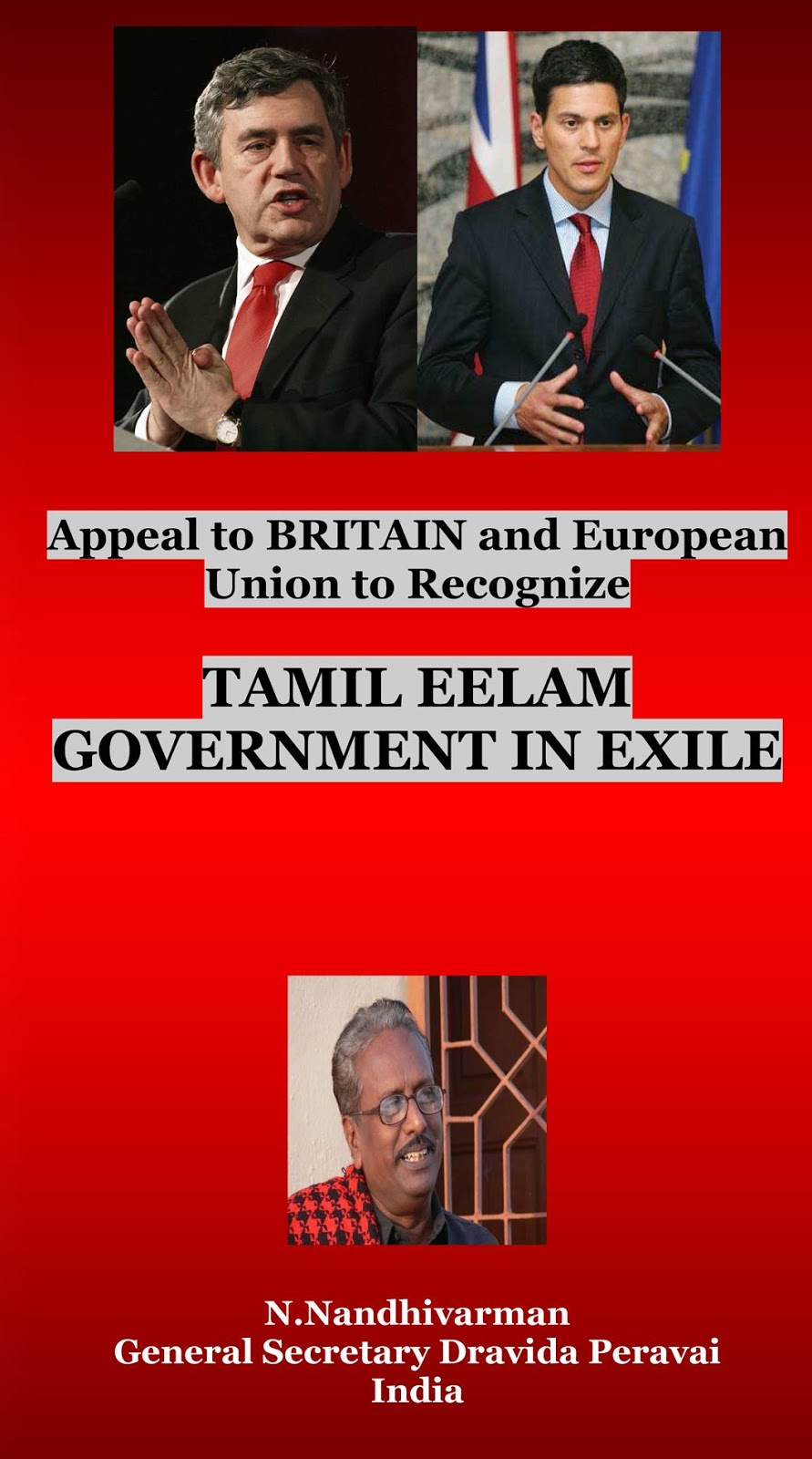
12.03.2010 :Support Tamil Eelam Government in Exile


1


Appeal to Presidents/Prime  Ministers of Member nations of European Union to support Tamil Eelam Government in Exile

Hon’ble Mr. Gordon  Brown. PRIME MINISTER

Hon'ble David Miliband , Secretary of State  for Foreign and Commonwealth Affairs 


 We from India on humanitarian grounds would be expressing our solidarity with Tamils of Eelam living across the continents in various countries  including Britain. Britain has special responsibility to resolve the Tamil question because it once ruled India and Ceylon and we now see a ray of hope in your utterances that reveal your sympathies too are towards Tamils of Eelam crushed by a genocidal war.

 We would like you to revisit January 1994 in your memory lane: A Year that led to the dissolution of three multinational federations namely Soviet Union, Czechoslovakia and Yugoslavia also gave birth to nineteen new states. Armenia, Azerbaijan, Belarus, Bosnia & Herzegovina, Croatia, Czech Republic, Georgia, Kazakhstan, Kyrgyzstan , Macedonia, Moldova , Russia, Slovakia, Slovenia, Tajikistan , Turkmenistan , Ukraine ,Uzbekistan and Yugoslavia [ Serbia and Montenegro ]. Three states namely Estonia, Latvia and Lithuania regained their independence. Chechnya in Russia and Kosovo in Serbia were engaged in struggle for independence.

European nations granted conditional recognition to these states. Therefore a precedent exists. When Tamil Eelam was struggling for independence Tamil Diaspora living in almost all of the European nations was in streets urging these nations to step in to redeem Tamils of Eelam from a genocidal war. Necessary alarm bells have been sounded and European nations which had established norms to recognize new nation states, could have applied their collective mind and proven their political will by extending the precedent to Tamil Eelam. But alas! That historical opportunity was lost by the saviors of civilized democracy whereas freedom aspiring people of Tamil Eelam failed to win recognition for their homeland nation.

In December 1991 EC Council of Ministers chose to recognize Yugoslav and [Soviet] Republics seeking independence. It was a conditional recognition. What are those conditions? Let me quote in verbatim:“The European Community and its member states confirm their attachment to the principles of Helsinki Final Act and the Charter of Paris, in particular the principle of self determination. They affirm their readiness to recognize, subject to the normal standards of international law, those states which following the historic changes in the region, have constituted themselves on a democratic basis, have accepted the international obligations and have committed themselves in good faith to a peaceful process and to negotiations. Therefore, they adopt a common position on the process of recognition of these new states, which requires:

 ► respect for the provisions of the Charter of United Nations and the commitment subscribed to the Final act of Helsinki and in the Charter of Paris, especially with regard to rule of law, democracy and human rights.► guarantees for the rights of ethnic and national groups and minorities in accordance with the commitments subscribed in the framework of CSCE► respect the inviolability of all frontiers which can only be changed by peaceful means and by common agreements► acceptance of all relevant commitments with regard to disarmament and nuclear non-proliferation as well as to security and regional stability.► commitment to settle by agreement, including where appropriate recourse to arbitration, all questions concerning state succession and regional disputes.

Let me remind you humbly the above quoted, Declaration on Guidelines on the Recognition of new states in Eastern Europe and in the Soviet Union and the Declaration on Yugoslavia: Extraordinary EPC Ministerial meeting [Brussels} / EPC Press Releases P 128 & 129 of 1991 dated 16th December 1991. Further the Congress of Berlin 1878 had spelt safeguards for minorities in the post First World War Settlements. These documents would have given the parameters to grant recognition for Tamil Eelam and Tamils in forefront of freedom struggle would have declared independence and sought recognition as laid in these precedents, but they lacked the initiative.

 Let me also remind the precedent laid by British Prime Minister Winston Churchill during the Second World War when he endorsed the setting up of Free French Government in Exile headed by Charles De Gaulle in British soil.

Now that Tamil Eelam is under occupation by forces of aggression recognition of Tamil Eelam Government after establishing it within Srilanka would not be possible today, though it could be justified. As immediate step Britain which once granted independence to Srilanka without resolving the ethnic question, due to historical compulsions of the post-Second World War conditions, could allow the setting up of Tamil Eelam Government in Exile. Such Government must pledge to the parameters laid down as mentioned in earlier paragraphs and collective recognition of that Tamil Eelam Government in Exile must emanate from Member Nations of European Community. Britain must take the lead to mobilize support for such initiative.

Perhaps India factor and Europe’s nobility to uphold Indian geo-political interests would have made European community speechless at the height of civil war in Srilanka. But now in the aftermath of the so-called ghost of terrorism laid to rest, when in country after country Tamils of Eelam through democratic process by way of referendums are expressing in favour of Independent Tamil Eelam, it is high time for European Union to recall the precedent laid and conditions spelt for recognition of states in last decade of last century in Europe. India too houses the Tibetan Government in Exile and it would not be an untouchable proposal if a democratic Government of Tamil Eelam attains independence.

To enlighten European Union and to awaken the Indian Union it would be our duty as responsible political party in India to recall the events that led to the birth of Bangladesh before placing you our pleas for Tamil Eelam. International law had not prohibited the creation of new states by way of secession, the Singapore [1965], Bangladesh [1971] and Eritrea [1993] precedents reveal. But here we wish to lay emphasis on Bangladesh secession since India was supportive of that secession.

Let me quote from the International Commission of Jurists, “The events in East Pakistan 1971’ [Geneva ICJ, 1972 page 69] “If one of the constituent peoples of a State is denied equal rights and is discriminated against, it is submitted that their full right of self determination will revive” It must be noted that self determination here meant the right to independence. India’s use of force in violation of jus cogens was mitigated by humanitarian concerns caused by the Pakistan’s campaign of violence against Bangladeshi people. We want to stress that India forgot its own precedent, forgot its own defense as reported in the Security Council debate [UN Doc S/PV 1606 dated 4 th December 1972] with regard to its justification for intervention in Bangladesh. Much grave crimes against humanity had been unleashed in a genocidal war against Tamils of Eelam. Yet India failed to follow its own Bangladesh precedent, may be due to hatred for the group that led the freedom struggle. Now that the much despised group had been eliminated, still Tamils of Eelam are not getting any justice under the Neo-Nazi Leadership of Srilanka President Mahinda Rajapakshe; time for introspection by India had arrived.

The Dublin Report of the People’s Tribunal which comes as annexure is one more recent indictment against the Rajapakshe Government. Hence we urge the nations of European Union collectively to recognize the right of self determination of Tamils of Eelam, and allow the setting up of a Government in Exile in their soil with their recognition.

International Covenant on Civil and Political Rights, as adopted and opened for signature, ratification and accession by General Assembly resolution 2200A (XXI) of 16 December 1966 entry into force 23 March 1976, in accordance with Article 49 , PART II ,Article 2 States: 1. Each State Party to the present Covenant undertakes to respect and to ensure to all individuals within its territory and subject to its jurisdiction the rights recognized in the present Covenant, without distinction of any kind, such as race, colour, sex, language, religion, political or other opinion, national or social origin, property, birth or other status.

We are ready to prove that on each count Srilanka had miserably failed, wantonly violated the provision, ever since it got independence. Tamils of Eelam were never for independence nor for total dependence but were for interdependence, and all democratic demands endorsed by Eelam Tamils in elections and voiced through their elected Parliamentarians were never fulfilled in past and in present too, even after claiming victory there seems to be no magnanimity or maturity to meet an international obligation to Tamil minorities, who first sought federalism and when failed to attain waged a civil war, and having lost the war Tamils are treated like slaves in their own soil. It is here we appeal to your conscience to consider other options for Tamils of Eelam.

Srilanka: Ground Reality

As long as article 2 of Srilankan Constitution says “the Republic of Srilanka is a unitary state” there is no room for federalism and all talk about political solution leads only to dead end. This article blocks political devolution. It is needless to say that political devolution means creation of states with sovereign legislative power on subjects allocated or earmarked for that provincial administration.

Then the other dangerous provision from the Tamils stand point is article 76 which states “Parliament shall not abdicate or in any manner alienate its legislative power and shall not set up any authority with legislative power”. If there is no political devolution or political decentralization, what the Government of Srilanka plans to offer on platter to Tamils is nothing but slavery.

 Whoever headed or heads the Srilankan Government, they were never for resolving the conflict satisfying the legitimate demands of the Eelam Tamils. This has to be borne in mind. The past must be evaluated before accepting at face value the verbal gymnastics of Srilankan President Mr.Mahinda Rajapakshe.

 Minimum Demands that were never met:
 The following would have satisfied legitimate demands of Eelam Tamils, if Srilankan Government had offered before launching the current genocidal war against Eelam Tamils.

 A] Repeal of the Article 2 of Srilankan Constitution to pave way for the introduction of federal form of governance, or for a con-federal system of government

B] Repeal of Article 76 to allow political devolution

 C] Amending the Article 18 to declare that “the official languages of Srilanka shall be Sinhala and Tamil, enforceable throughout the country without any restrictions.

 D] Amending Article 9 to delete “the foremost place” granted to Buddhism and to declare Srilanka a secular state.

These could be termed as minimum demands that could have satiated the Tamils of Eelam before current genocidal war. These were the demands voiced from much before British left Ceylon, and were the theme of many broken pacts and failed promises, in which Srilankan Governments remains the unique country that adopted ethnic cleansing through genocide successfully, while the conscience keepers of this world must rise up to the occasion even though belatedly to support Tamil Eelam Government in Exile.

 India too fails: The Indo-Srilankan Agreement of July 1987 paved way for the temporary merger of Northern and Eastern provinces into a unified North- Eastern Province. This merger was to be endorsed by a referendum before the end of 1988. One Provincial Council was set up in North-Eastern Province as well as 7 other provinces. In order to implement this accord Mr.Rajiv Gandhi sent the Indian Peace Keeping Force in the first week of August 1987. The pressure brought by Mr.Rajiv Gandhi also made LTTE agree to cessation of hostilities. LTTE also started handing over weapons to IPKF. So far everything went well. Then how this accord was sabotaged and who torpedoed it? A general amnesty was granted under the accord to “political and other prisoners now held in custody under the Prevention of Terrorism  Act and other Emergency laws, and to combatants, as well as those persons accused, charged and or convicted under these laws.”
 Government of Srilanka, known for treachery which current breed of politicians may have erased from memory withheld amnesty to 1250 Tamil political prisoners. This was done by twisting the amnesty clause to say that it applied only to NEP and not offences committed outside North Eastern Province. LTTE retaliated by suspending surrender of arms.

 Now, to trust Mr.Rajapakshe that after eliminating terrorism, he has a peace formula under his red towel, which he will wave along with olive branch, would amount to total ignorance of the history of betrayals, for which many Sinhalese rulers till now are held accountable before the conscience of the world.

Racial Riots in 1883 hit Christians in 1902 Dalits, in 1915 Muslims, in 1930 Malayalees, then Plantation Tamils and from 1983 Eelam Tamils:

Nazism is not dead, and just because it thrives in a tiny island, it need not be condoned or ignored. The problem with Sinhalese is not Tamil-phobia. They are against everybody. The seeds of hatred are ingrained in their brains. A scholar Kumari Jayewardene, a Sinhalese herself, had chronicled the history of clashes and communal unrest in Srilanka. The starting point of Tamil Sinhala ethnic clashes are considered to be 1983. But hundred years before that, in 1883 the Sinhalese turned their ire against Catholics. The Buddhist religious firebrand Anagarika Dharmapala criticizes the British for their religion.

“When the ancestors of the present holders of our beloved land were running naked in the forests of Britain with their bodies painted and later on when their ancestors had gone under the imperial rule of Rome and some of them were being sold as slaves in the market place of Rome, our ancestors were already enjoying the fruits of glorious and peaceful civilization. Buddhism was the religion of the state in Ceylon like the Church in England in the British isles” proclaims Anagarika Dharmapala, forgetting what the sacred book of the Sinhalese, known as Mahavamsam says about the first originator of the Sinhalese race.

Born to parents who are cross breed between a Lion and a Princess that too born to a brother and sister incest couple, the unruly Vijayan driven by his father with such credentials, landed in Srilanka and married local women, i.e. Tamil, even a Pandyan princess. Then how come Sinhalese can claim racial superiority or purity. Like Anglo Indians, they are half Tamil, half foreign. So assuming they are racially superior, the Sinhalese called Christians barbarians and launched attacks in 1883. Then in 1915, Sinhalese wanted to drive away the North Indian and South Indian Muslims.

“The Mohammedans, an alien people, who in the early part of the nineteenth century were common traders, by Shylockan methods became prosperous like the Jews. The alien South Indian Mohammedan comes to Ceylon, sees the neglected illiterate villagers without any experience in trade, without any knowledge of any kind of technical industry and isolated from whole of Asia on account of his language, religion and race, and the result the Mohammedan thrives and the son of the soil goes to the wall……..What the German is to the British that the Mohammedan is to the Sinhalese by religion, race and language. He traces his origin to Arabia” incited the same Anagarika Dharmapala. Violent attacks, arson, looting were unleashed against the Muslim traders in 1915.

Readers of both the quotes from a Sinhala firebrand who planted seeds of hatred between communities and who is one among those who ignited communal clashes must take note of a contradiction in his statement. While speaking about British in 1883 he claims Sinhalese were enjoying the fruits of glorious and peaceful civilization. But in 1915, he admits that Sinhalese have no experience in trade and are without any kind of knowledge. Then how could they be the architects of the glorious and peaceful civilization. And that civilization must be of the Tamils, who can establish the fact with historical and archaeological evidences right up to Indus valley.

In between 1883 and 1915, other unfortunate riots hit the dalits from India, who had gone to Ceylon as plantation labour. The arrogant Sinhalese refused to drink tea plucked by untouchables. Later in 1930 the Sinhalese turned their ire against the 30,000 Malayalees, who had gone to Ceylon from Travancore- Cochin state. A trade union leader A.E.Kunasesinghe launched the racial fire against them by his fiery speeches.

Between 1871-1881 when coffee, tea plantations came up in large numbers in Ceylon, lots of Tamils from India went there seeking work. They constituted nearly 10 % of the then population of Ceylon. Donoughmore Commission constituted before independence said out of these roughly 50 percent labour were permanently residing in Ceylon. Jackson Report of 1928 said they were around 60 percent. The Soulbury Commission of 1946 stated 80 percent of these labour were permanent residents of Ceylon.

Donoughmore Commission had recommended that for all those who had lived for 5 years and above citizenship rights must be conferred. Ceylonese Government did not accept that recommendation, thus the crisis started. In 1940 both India and Ceylon discussed this issue. Again in 1941 September there was a bi party conference between India and Ceylon. The agreed joint declaration which emanated in this meeting was not implemented.

The irony is that in 1942 Ceylonese Government itself had written to Indian Government requesting India to permit labour to come and work in its rubber plantations. In the first General Elections of 1947 plantation labour had voting rights. They backed the Ceylon Indian Congress and elected 7 members to Parliament. They were the deciding factor in another 20 Parliamentary constituencies.

 D.S.Senanayaka, first Prime Minister of Ceylon amended the 8 th article of  the Citizenship Act and disenfranchised plantation Tamils called as Malayaga Tamils. He passed in Parliament the amendment by the year 1949 and removed people of Indian origin from the voters list. That is how the voting rights of plantation Tamils who chose 7 Members to Parliament were deprived from them. Then Indian origin people were asked to apply for citizenship. 8, 25,000 people applied for citizenship. Only to 1, 00,000 people Ceylonese citizenship was granted. To resolve this deadlock at London both Indian Prime Minister Jawaharlal Nehru and Ceylon Prime Minister Dudley Senanaiyaka talked but could not resolve. In 1954 a pact was signed between Jawaharlal Nehru and Sir John Kotewala, Ceylon Premier. It was never implemented. By 1964, Srilankan Prime Minster Srimavo Bandaranaike and Indian Prime Minister Lal Bahadur Shastri signed a pact, wherein Srilanka agreed to give citizenship to 3, 00,000 persons. India admitted to take back 5,25,000 persons.

"All American people were once migrants from Europe. Yet no European country foolishly signed a pact with America to take back its citizens. Even after signing such a pact India had left more than 2, 00.000 people of Indian origin in Srilanka.

Sinhala Racism in Parliament:

 Mr.D.M.Chandrapala, Sinhalese Buddhist Member of Parliament from Kundasale spoke the following words in Srilankan Parliament on July 1981. “Now Sir… what should we do to this so called leader of the Tamils? If I were given the power, I would tie him to the nearest concrete post in this building and horses whip him till I rise to his wits. Thereafter let anybody do anything he likes, throw him into the Beire [lake] or into the sea, because he will be so mutilated that I do not think there will be life in him. That is war.”
 Can anyone in civilized world in any of the democracies of the world, could have heard such a speech. That speech too is against democratically elected Tamil leaders demanding federalism and not independent state at that juncture. There was no terrorist in Parliament yet if Sinhala Parliamentarian spits such venom, how could Tamils live within unitary Srilanka,

 Mr.G.V.Punchinilame M.P from Ratnapura spoke in Srilankan Parliament in July 1981. “Since yesterday morning, we have heard in this Honorable House about the various types of punishment that should be meted out to them {Tamil Parliamentary Members}. The M.P from Panadura Dr.Neville Fernando said there was a punishment during the time of Sinhalese kings, namely, two areca nut posts are erected, these two posts are then drawn toward each other with a rope, then tie each of the feet of the offender to each post and then cut the rope which will result in tearing apart the body. These people should also be punished in the same way.

 …………..some Members suggested that they should be put to death on the stake, some other Members said that their passports should be confiscated, still other Members said they should be made to stand at the Galle Face Green and shot at. The people of this country want and this government is prepared to inflict these punishments on these people.”

If in Srilankan Parliament such barbarian punishments are sought against duly elected Tamil Members of Parliament even in 1981 much before the birth of militant movements, how can Tamils live under unitary Srilankan state? It is time to read the speech of the cunning fox Mr.J.R.Jayawardane, President of Srilanka, which appeared in Daily Telegraph of 11th July 1983. “I am not worried about the opinion of the Tamil people…… now we cannot think of them, not about their lives or their opinion….. the more you put pressure on the North, the happier the Sinhala people will be here… Really if I starve the Tamils out, the Sinhala people will be happy.” Mr.Mahinda Rajapakshe used starvation as weapon to make Tamils slaves and even now he handles that same weapon, a weapon much sought by Srilankan President of 1983 is still in use till 2010.Similarly there is no race on Earth called Sinhalese. Race itself is a myth, culture oriented, proven in our days when all humans have common genes. Yet under the illusion they are Aryans, a barbaric tribe claimed separate status for them, in spite of their own mythology tracing their root to a marriage between a Lion and Human Princess. The superiority complex leads Sinhalese to work overtime to ethnic cleansing, hence genocide in Srilanka starts from 1956 itself. The failure of the British to resolve many issues before granting independence to Ceylon had left Tamils at receiving end of genocide. Hence, Dravida Peravai urges Great Britain to play an active role in view of its association with India and Ceylon and its moral duty to clear the garbage accumulated in civilized governance of Ceylon.

The Indian sub continent was ruled by Tamils, their Empires disintegrated, deluge and other natural calamities struck at the Tamil land. Later in British period on their eve of departure there were 11 Presidencies and 562 princely states, which when the winds of nationalism blew over Indian sub constituent were welded together as Indian Union under a Constitution of India. The problems left over by colonialism, be it border dispute with China or Kashmir still bleeds India. Same problems galore haunt Ceylon. As head of Commonwealth too Britain has locus standi to intervene to correct past mistakes.

Let me recollect a tiny problem between India and Bangladesh which got its independence with India’s help. “The rulers of two princely states of Kooch Bihar and Rangpur within the Old Bengal Presidency during British rule in India lost their territories to each other playing the gambling by cards. There are till date 111 Indian enclaves in Bangladesh and 51 Bangladesh enclaves within India, as a result of this gamble by 2 princely states.’ Yet no one had the moral courage to resolve even this issue which every government keeps in cold storage. Hence it would not be prudent for all Member Nations of UN or of Commonwealth or of European Union to pin hopes on India alone to redeem Tamils of Eelam from slavery and to recognize their right to self determination.


TAMIL EELAM GOVERNMENT IN EXILE MUST BE RECOGNIZED BY GOVERNMENT OF BRITAIN AND ALLOWED TO FUNCTION FROM BRITISH SOIL.

TAMILS OF EELAM MUST ELECT THEIR REPRESENTATIVES THROUGH REFERENDUMS IN THE COUNTRIES THEY LIVE NOW, AND SUCH REPRESENTATIVES MUST CONSTITUTE THE GOVERNMENT OF TAMIL EELAM IN EXILE.

ALL TAMILS WITHIN SRILANKA MUST BE SUPORTED TO FORM A TAMIL EELAM IN THAT SOIL. TOWARDS THAT GOAL WORLD GOVERNMENTS MUST BACK TAMIL EELAM GOVERNMENT IN EXILE.

BRITAIN AND EUROPEAN UNION CAN TAKE THE FIRST INITIATIVE…..

AIADMK spent Rs 641 crore in 2016 to bribe its way back to power Documents reveal that AIADMK spent Rs 641 cr in 2016 to bribe its ...