Showing posts with label jayalalithaa. Show all posts

Tuesday, April 16, 2019

AIADMK spent Rs 641 crore in 2016 to bribe its way back to power

Documents reveal that AIADMK spent Rs 641 cr in 2016 to bribe its way back to power
35-Buying-the-mandate
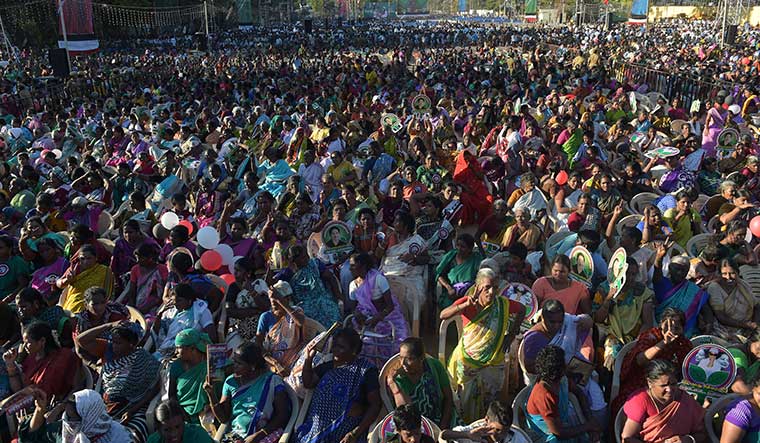
IN TAMIL NADU, the tradition of buying votes continues to flourish. With elections in 39 Lok Sabha constituencies and byelections in 18 assembly seats round the corner, the Election Commission and income tax department officials have seized a record Rs 137 crore of unaccounted cash from across the state.
The single-largest haul was the Rs 11.53 crore seized from properties linked to DMK treasurer Durai Murugan, whose son Kathir Anand is the party candidate in Vellore. Durai Murugan alleges that the Central and state governments are playing dirty tricks. “The ruling AIADMK is bribing voters. But the DMK is being targeted,” said a leader.
It was the DMK, however, that perfected the art of distributing cash for votes. In 2009, in the run-up to the assembly bypoll in Thirumangalam in Madurai district, the party allegedly distributed envelopes containing voting slips and Rs 5,000 in cash along with the newspaper. The experiment was so successful—the DMK won by nearly 40,000 votes—that it came to be known as the ‘Thirumangalam formula’.
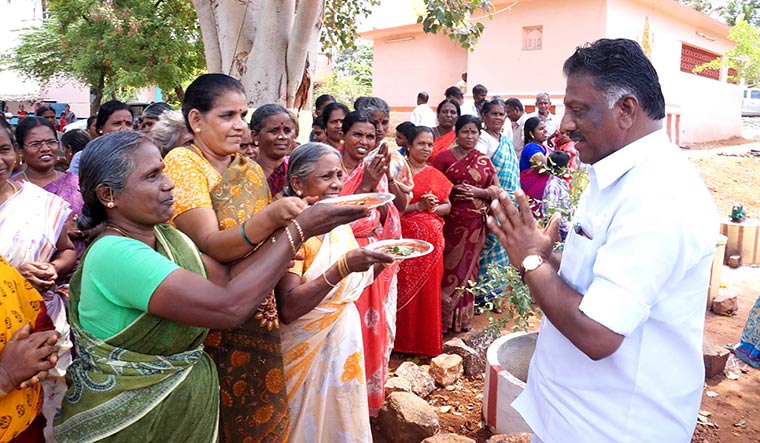
In the dock: O. Panneerselvam campaigning in 2016.In the dock: O. Panneerselvam campaigning in 2016.
Then the AIADMK scaled up the cash-for-votes enterprise. In the assembly elections in 2016, it allegedly gave Rs 250 each to voters across the state, which helped the party return to power by winning 134 of 234 seats. Documents accessed by THE WEEK show that as much as 70 per cent of voters in some constituencies were bribed by AIADMK leaders. Surprisingly, the Election Commission is yet to take any action.
On May 9, 2017, the principal director of income tax (PDIT) sent a note to the director-general of income tax investigation, detailing the way cash was distributed to voters in the run-up to the assembly polls. The note cites documents seized in December 2016 from the Chennai offices of SRS Mining, in which controversial businessman J. Sekar Reddy is a partner.
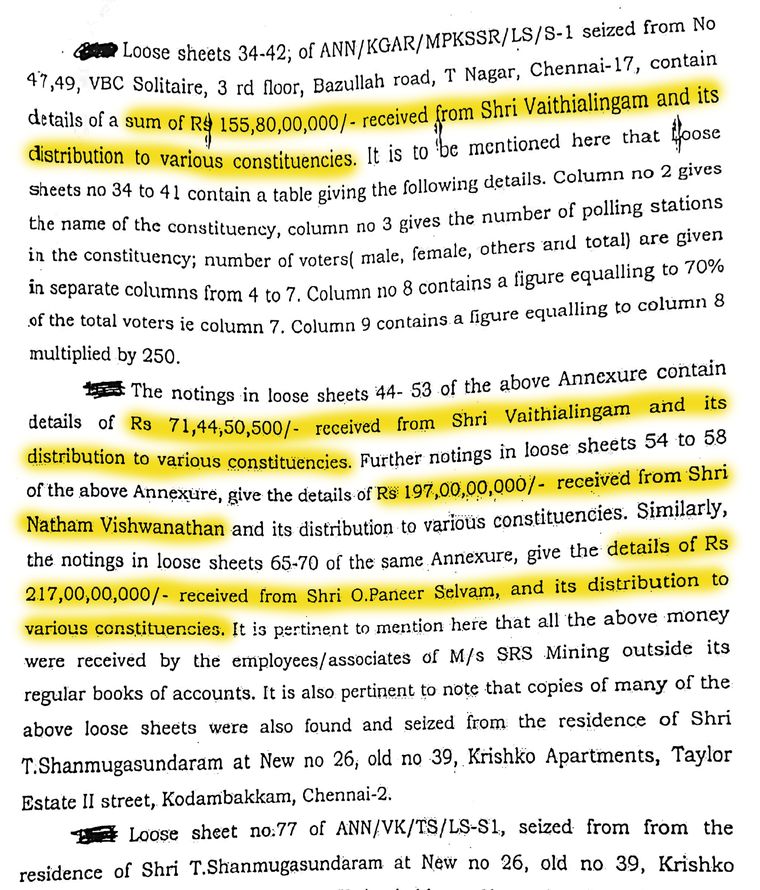
The PDIT wrote that SRS Mining “sourced” Rs 227.25 crore from housing minister R. Vaithilingam, Rs 197 crore from electricity minister Natham Viswanathan and Rs 217 crore from public works minister O. Panneerselvam. “The money so received (Rs 641.25 crore) was redistributed, apparently to various AIADMK candidates, by the employees and associates of SRS Mining and its partners,” said the note.
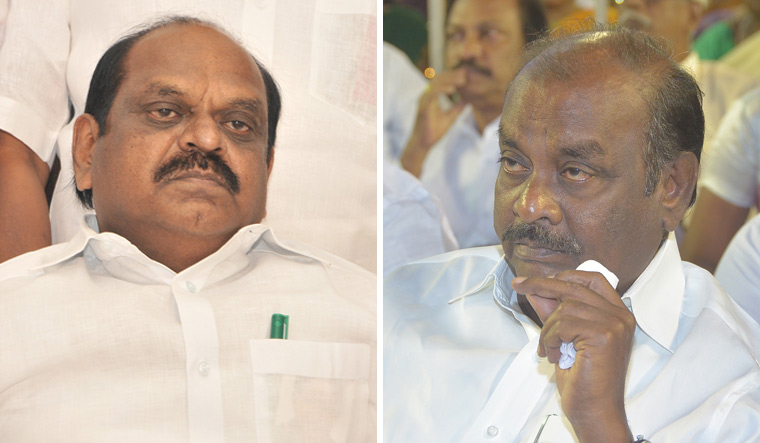
R. Vaithilingam and Natham Viswanathan. All three were ministers in the Jayalalithaa government, and their names figure in the 2017 income tax note | R.G. SasthaR. Vaithilingam and Natham Viswanathan. All three were ministers in the Jayalalithaa government, and their names figure in the 2017 income tax note | R.G. Sastha
The preparations for bribing voters apparently started in 2015, when it became clear that the popularity of the AIADMK government led by chief minister J. Jayalalithaa was on the wane. By October that year, the party had prepared a detailed chart based on the voters list in each constituency.
“[Documents seized] contain a table giving the following details,” said the note. “Column 2 gives the name of the constituency. Column 3 gives the number of polling stations in the constituency. Number of voters—male, female and others—and their total are given in columns 4 to 7. Column 8 contains a figure equalling 70 per cent of total voters. And column 9 contains a figure equalling [the figure in] column 8 multiplied by 250.”
The voters were profiled based on their family background, financial requirements and political allegiances. Caste, community and the number of votes in each household were then factored in to decide on the amount to be paid.
Three AIADMK ministers gave Rs 641.25 crore to distribute to voters across the state, says an income tax department note prepared in 2017Three AIADMK ministers gave Rs 641.25 crore to distribute to voters across the state, says an income tax department note prepared in 2017
“[The money given by the three AIADMK ministers] were received by the employees/associates of SRS Mining outside its regular books of accounts,” said the PDIT note. “It is also pertinent to note that copies of many of the [documents] were seized from the residence of [SRS Mining employee] T. Shanmugasundaram in Chennai, [and they give] details of cash amounting from Rs 25 lakh to Rs 1 crore paid to various candidates.”
THE WEEK’s investigation revealed that bundles of cash were transported, at least three months before polling, to 226 assembly constituencies. The money was kept in houses owned by the AIADMK’s ward members and grassroots leaders.
“It was split, booth-wise, in each constituency,” a former AIADMK minister told THE WEEK. “Weeks before the election, it was distributed to party functionaries in charge of the booths. On May 14, two days before polling, they visited each household like a neighbour and gave Rs 250 per vote. If there were four votes in a house, we gave Rs 1,000.”
The note says actor-turned-politician Sarathkumar got Rs 2 croreThe note says actor-turned-politician Sarathkumar got Rs 2 crore
In some constituencies, AIADMK leaders paid the visits as part of their morning walk. In some others, voters were called after 10pm. “We ensured that the money reached every voter whom we thought would vote for us,” said the former minister.
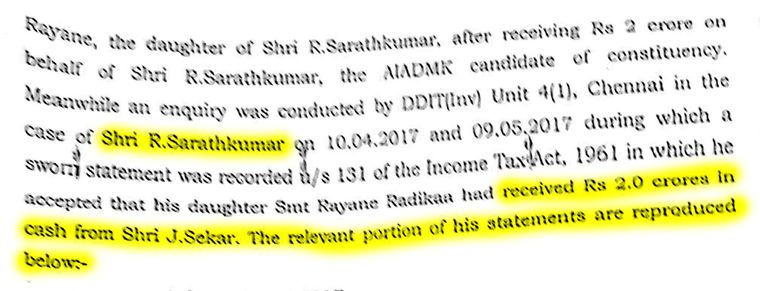
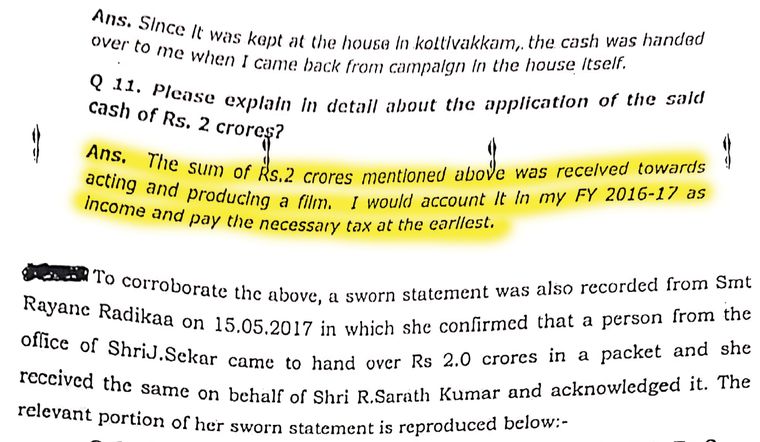
Documents seized from Shanmugasundaram’s house had acknowledgements from AIADMK candidates who received funds. “One such sheet carries the acknowledgment of Ms Rayane, daughter of R. Sarathkumar,” said the PDIT note. An actor-turned-politician, Sarathkumar had contested from Tiruchendur under the AIADMK symbol.
In April and May 2017, the IT department recorded the sworn statements of both Rayane and Sarathkumar, in which they admitted to having received Rs 2 crore from J. Sekar Reddy in May 2016. Sarathkumar said the transaction was not recorded in the books, and that he learnt of it while he was campaigning in Tiruchendur. “The cash was received by my daughter… who informed my staff about it,” he told IT officials. “The sum of Rs 2 crore was received towards acting and producing a film. I would account it as income in 2016-17 and pay the necessary tax at the earliest.”
The note cites Sarathkumar’s sworn statement, in which he said he had received the money for producing and acting in a filmThe note cites Sarathkumar’s sworn statement, in which he said he had received the money for producing and acting in a film
THE WEEK tried contacting Shanmugasundaram, but his whereabouts remain unknown. Sarathkumar suggested that the issue mentioned in the PDIT note was not relevant to the bribery charges. “My income tax matters have been explained to the concerned officers,” he informed THE WEEK.
The PDIT note cites the money received by Sarathkumar as clinching evidence of the money trail. “The information has been communicated to the director-general of investigations (IT department) for onward transmission to the Central Board of Direct Taxes for intimating the Election Commission of India,” the note said.
A senior IT official in Chennai told THE WEEK that the department had raided properties belonging to “several VIPs” to corroborate their findings. “We found strong evidence of the AIADMK having spent huge money to bribe voters,” said the official. “The IT cases against the VIPs are ongoing. But it is for the Election Commission to take action as regards to bribing of voters.”
The commission is yet to act. It has not even acknowledged THE WEEK’s RTI queries on the matter, which were filed on February 14.
When asked about the bribery allegations against him, Sekar Reddy said the IT department had not seized any incriminating material from properties linked to him. “The IT department never made inquiries on such lines,” he told THE WEEK. “The panchanama [a legal statement prepared after a seizure or arrest] given to me after the raids also do not mention this. I have already clarified that I do not have the habit of keeping a diary. So any note about these details in my account books is not true.”
When asked about the PDIT note, Natham Viswanathan said, “There is no truth in it. We did not distribute cash. In 2016, the people wanted Amma (Jayalalithaa) to continue her welfare government. So we were voted back to power.”
Vaithilingam and Panneerselvam have not responded to THE WEEK’s queries. “I am campaigning. I do not have time to talk now,” said Vaithilingam. Ashok Thomas, public relations officer in the deputy chief minister’s office, said he had forwarded the queries to Panneerselvam.
The Election Commission had registered 101 cases of poll-related bribery across 98 constituencies in May 2016. Most of the cases are in limbo now. It had also countermanded voting in three constituencies, where it suspected that voters had been bribed. All three constituencies were won by the AIADMK in bypolls held later that year.
“In some places, the bribe went up to Rs 1,000 per vote,” said D. Ravikumar of Viduthalai Chiruthaigal Katchi, who is contesting this Lok Sabha elections from Villupuram constituency as part of the DMK-Congress alliance. “The AIADMK distributed cash to win the 2016 assembly elections. We all witnessed it. I had contested from the Vanur assembly seat in Villupuram then. I was not able to fight the might of money.”
Perhaps, the voters themselves are to blame. The blockading of a street in the run-up to the Pudukottai assembly bypoll in 2012 is a case in point. When the police turned up to disperse the crowd, they were shocked to hear demands for money. People complained that their relatives nearby had received cash for votes, and that they were left out.
Over the years, the malaise has only worsened. “It is not just the downtrodden [who are demanding money],” said veteran journalist R. Ramasubramanian. “People belonging to the middle and upper middle classes have also started expecting cash. Politicians are looting our money, they say. So what is wrong in accepting what is basically our money?” 

TAGS

DEFEAT JAYALALITHAA AND SASKALA CORRUPT QUEENS AND THEIR SLAVES ONCE FOR ALL in 2019


Saturday, September 29, 2018

TAMILNADU ASSEMBLY RESOLUTION ON PRABAKARAN REVEALS JAYALALITHAA DID NOT FOLLW MGR's PATH


Prabhakaran's extradition:

IS IT MGR's PATH

TNN | Apr 16, 2002, 22:10 IST [ Courtesy : News } 

Chennai: Even as Pattali Makkal Katchi (PMK ) members expressed their protest by wearing black shirts and shouting slogans, the Tamil Nadu assembly on Tuesday passed a resolution urging the centre to take steps to expedite the extradition of LTTE Supremo V. Prabhakaran, the alleged mastermind behind the Rajiv Gandhi assassination. The centre should pursue with Sri Lanka for the deportation of Prabhakaran through diplomatic and other channels for his trial in India, the house said. the resolution states that if Sri Lanka was unable to apprehend and deport Prabhakaran, the Indian government, with the permission of Sri Lanka, should send armed forces to assist the island country in capturing Prabhakaran. the resolution was moved by Chief Minister J. Jayalalithaa, who seem to be taking on the LTTE head-on, as she had done in 1991-96.

The main opposition DMK remained neutral on the resolution. after shouting slogans like ``vanjikade vanjikade tamizhazhgalai vanjikade'''' (do not victimise tamilians), ``podathe podathe tamizhazhgaleke edirake theermanam podathe'''' (do not adopt resolution against the tamilians), ``kedukathe kedukathe tamizhazhgalin amaidi pechai kedukathe'''' (do not spoil the peace talks of the tamilians).

The resolution, without naming LTTE spokesperson Anton Balasingham, urged the centre not to allow even a toe-hold for LTTE members in the country in the interest of India's integrity, sovereignty and security. ``The Tamil Nadu people were greatly shocked by the April 10 press conference of Prabhakaran in Kilinochchi,'' said the resolution, rejecting LTTE''s "forget the past" stand. 

"India cannot keep its eyes closed when the leader of the most dreaded terrorist organisation holds an international press conference to say his organisation would continue its fight for a separate Tamil nation. Time has come for the centre to take action to capture Prabhakaran,'''' Jayalalithaa said, moving the resolution. the resolution emphasised that nobody from the banned LTTE be allowed to enter India. though the LTTE had been notified as a terrorist organisation under POTA 2002, the organisation and its other support groups continued to pose a threat to the nation. entities like the TNLA and TNRT not only directly or indirectly supported the LTTE, but also got assistance from it. ``so, we had to ban the two outfits in November under the criminal law amendments act 1908,'''' the resolution said. but the resolution, adopted through a voice vote, made it clear that the state government and its people would be happy if peace returned to Sri Lanka, particularly in the Tamil-speaking Jaffna area. Peace in northern Sri Lanka would also create a conducive atmosphere for refugees in Tamil Nadu to return to their country. Jayalalithaa contended that the Indian government should lobby with the neighbouring states for good neighbourly relations. ``but that is no reason for laxity in bringing Prabhakaran here for trial.'''' justifying the proposal seeking the deployment of the Indian army in Sri Lanka, Jayalalitha said when the us could take steps to catch Osama bin laden after the September 11 attack, India should do the same to apprehend Prabhakaran. while leaders from all parties admitted that Prabhakaran should face trial, concern was raised that the resolution should not hamper the Norway-brokered peace talks. most of those who opposed the move or stayed neutral were against sending the army to the island nation.

Friday, September 14, 2018

JAYALALITHAA"S TANTRUMS : ARTICLE 356 : DILEMMA OF BJP GOVERNMENT :1998


Vol. 15 :: No. 14 :: July 04 - July 17, 1998 

Who's afraid of Article 356?

More than any particular State government, it is the BJP-led Government at the Centre that finds its survival to be at stake because of the politics of Article 356.
SUKUMAR MURALIDHARAN
in New Delhi

THERE would seem to be nothing more futile than seeking enlightenment from ongoing controversies over the invocation of Article 356 of the Constitution to dismiss elected State governments well before their full term. They suggest little else than restive politicians of unbridled ambitions and acute insecurity trampling upon the foundations of constitutional rule.
Coalition government is known to induce a sense of restraint among the principals - a tacit recognition of the proprieties involved in mutual association. Harmony arises from a willingness to engage coalition partners in dialogue in an environment of sobriety and restraint.
Yet a paralysis of dialogue appears to be the most distinctive feature of the 100-day-old coalition Government at the Centre. The early clamour of competing demands from the coalition partners was met through the simple expedient of pressing the nuclear trigger, blasting the nation into a future of ethical confusion and multiplying strategic hazards. Dissent was silenced for a while, but did not take long to resurface.
ANU PUSHKARNA 
Prime Minister A.B. Vajpayee and Union Home Minister L.K. Advani with AIADMK general secretary Jayalalitha. Ironically, right now, Article 356, a knife placed in the hands of the Centre for use against State governments in claimed defence of the Constitution, seems to pose a more real threat to the survival of the BJP-led coalition at the Centre.
Once Pakistan established that far from attaining the exalted status of a nuclear weapon power, India had only managed to achieve a deadly strategic symmetry with a smaller and much weaker neighbour, the old litany of partisan demands from coalition partners was quick to emerge again. Although numbing in their triviality, transparent in their motivations and fraught with enormous dangers for the foundations of constitutional rule, these demands have already paralysed the task of governance and brought the Atal Behari Vajpayee Ministry perilously close to the brink
.
The mood was sombre when the Coordination Committee of the ruling coalition met for only the second time on June 27. Jayalalitha, leader of the All India Anna Dravida Munnetra Kazhagam, who has the presumptive loyalty of no fewer than 29 members in the Lok Sabha, stayed away. She had been engaged in a war of words with the Bharatiya Janata Party leadership over the preceding week, but had seemed to relent when Prime Minister Vajpayee spoke personally to her a few days ahead of the planned meeting of the Coordination Committee. It was obvious that Jayalalitha needed a decisive intervention from the Union Government that would at least partly assuage her political insecurities. After Vajpayee's telephonic conversation, it seemed a possibility that she would settle for a deal that did not go so far as to dismiss the elected State Government of Tamil Nadu a full three years ahead of its term.

Jayalalitha cited health grounds in crying off from participation in the Coordination Committee. But her disinclination to participate in any collective political body which fails to accord her the pre-eminence that she views as a unique prerogative was apparent. The failure of collective functioning in the ruling coalition bears ominous portents for its future. But its tendency to play along partly with the irrational demands of its alliance partners suggests more immediate dangers to constitutional well-being and political federalism.
S. ARNEJA
Leaders of the BJP and some of its alliance partners at the meeting of the Coordination Committee in New Delhi on June 27. Leaders of several allies of the BJP did not participate in the meeting.
OTHER constituents of the ruling coalition have receded to the background only because Jayalalitha has taken the forward position in demanding the use of Article 356. But the Samata Party in Bihar and the Trinamul Congress in West Bengal are deeply disaffected by their inability to use leverage at the Centre to get their way in the respective States. The Samata Party clearly believes that its internal cohesion can only be assured by the proximity of power at the State level.

At the Coordination Committee meeting, Samata Party representative Nitish Kumar did reiterate his demand that the Rabri Devi Government in Bihar be dismissed and fresh elections ordered. He was met with a reiteration of the BJP's position that Article 356 enshrined an emergency power which was not obviously invoked in the case at hand. Nitish Kumar did not press the point, but his sense of vulnerability is acute. His political constituency in Bihar is yet to partake of the fruits of power, and his bitter adversary, Laloo Prasad Yadav, has begun an assiduous courtship to win them over.

The Samata Party's constituency does not have a natural affinity with the BJP brand of politics, and its susceptibility to Laloo Prasad's appeal - particularly when it is buttressed by the apparatus of power in the State - cannot be underestimated. For the Samata Party, removing Laloo Prasad's proxy Government in Bihar is clearly a matter of self-preservation. Till Jayalalitha queered the pitch for them, they seemed to have a receptive audience within the BJP. No less a leader than Vajpayee had repeatedly during the recent election campaign referred to Bihar as an appropriate case for the exercise of Article 356. But with Jayalalitha having reduced the emergency power of 356 to little more than an instrument of political vendetta, the Samata Party's case also lost much of its credibility.
SHANKER CHAKRAVARTY
Samata Party leader and Railway Minister Nitish Kumar. The partisan demands of the BJP's allies for the dismissal of State governments are fraught with enormous dangers for the foundations of constitutional rule.
Jayalalitha and her allies won overwhelmingly in Tamil Nadu in the last Lok Sabha elections. The Samata Party in alliance with the BJP won fairly substantially in Bihar. The Trinamul Congress, which performed modestly in West Bengal, completes the trio of Article 356 militants which is making things awkward for the Vajpayee Ministry.
Trinamul Congress leader Mamata Banerjee failed to work out an acceptable modus vivendi with the BJP for the elections to local bodies in West Bengal in May. Any hopes that she may have entertained of breaking into the ruling Left Front's bastions of rural strength were quickly dispelled. 

This impelled her to raise the stakes and demand the use of Article 356 in West Bengal. The underlying intent is obviously to simulate the conditions of repression that prevailed in 1972, which was the last occasion when the Congress party won an election in West Bengal.

IT is tempting to read deep democratic scruple in the BJP's refusal to entertain the demands of its recalcitrant allies. But perhaps the truth is that it is deterred by the various practical difficulties involved. Any precipitate action using Article 356 would unsettle the loyalty of various partners of the ruling coalition, such as the Akali Dal in Punjab and the Telugu Desam Party in Andhra Pradesh. Once the debits are added up, there is unlikely to be much accruing to the credit of the BJP from the utilisation of the draconian powers under Article 356.
SUSHANTA PATRONOBISH
Trinamul Congress leader Mamata Banerjee. Her party is pressing for some form of Central action against the Left Front Government in West Bengal, based on exaggerated charges relating to the law and order situation.
A further factor is the virtual impossibility of getting a proclamation of President's Rule in any State approved by both Houses of Parliament within the stipulated period of two months. Passions have always run high over Article 356, but the Congress had, all through its years of comfortable ascendancy, no reason to believe that Parliament would actually exercise a power of scrutiny. In today's more fragmented political milieu, that can no longer be taken for granted. A certain degree of zeal in the exercise of parliamentary scrutiny, especially in a cause with such deep partisan resonances, is an integral part of current realities.

A peculiar feature of the present situation, however, is that any proclamation of President's Rule may not even reach the stage of parliamentary scrutiny. Since the tumultuous events in Uttar Pradesh in February, the possibility of the higher judiciary imposing an interim injunction on the dismissal and appointment of Ministries has become a factor to reckon with. That followed a grossly mala fide exercise of authority by the Governor of the State, Romesh Bhandari, in dismissing the Kalyan Singh Government on the strength of his subjective satisfaction that it had lost its legislative majority. This was under the scope of Articles 163 and 164 of the Constitution, which accord the Governor a limited power of "discretion" in the appointment of a Ministry.

The Supreme Court laid down in S.R. Bommai versus the Union of India that any proclamation under Article 356 is subject to judicial review. The argument that the imposition of President's Rule belongs to a special category of emergency powers that cannot be the subject matter of litigation has long since been thrown out of court. 

Jayalalitha may have done her political adversaries in Tamil Nadu the greatest favour by announcing that the dismissal of the Tamil Nadu Government was an integral part of an agreement that she had struck with the BJP prior to the Lok Sabha elections. This makes any invocation of Article 356 in the foreseeable future a highly colourable exercise of power for reasons that have no legitimacy in the constitutional scheme. Jayalalitha has, unwittingly or otherwise, already laid sound foundations for the judicial quashing of the decision she seeks with such fervour from the Central Government.

CALCULATIONS of realpolitik are obviously a decisive element in the BJP Government's current posture of reticence as far as Article 356 is concerned. Moreover, citing law and order as a basis for dismissing elected State governments would cut the BJP's Ministries in Uttar Pradesh and Rajasthan very close to the bone. It would also unsettle the Andhra Pradesh Government, and leave Farooq Abdullah in Jammu and Kashmir with little reason to remain in office.
T.A. HAFEEZ
In April 1989, Karnataka Chief Minister S.R. Bommai (left) presents Governor P. Venkatasubbiah a copy of the resolution passed by the Janata Dal Legislature Party requesting the Governor to give him an opportunity to test his majority in the Assembly. He was denied the opportunity and his Government was dismissed, and eventually the Supreme Court laid down in the Bommai case that any proclamation under Article 356 is subject to judicial review.

Since the Supreme Court ruling in Bommai, further judicial interventions have been rare. This is partly because there have been few cases of a State Governor or the Central Government invoking the power of dismissal. The events in Uttar Pradesh in November 1997, and then again in February 1998, may have turned the tide. Arbitrary exercises of power can now be challenged in higher judicial forums and if a reaffirmation of the Bommai findings were to be sought, the BJP governments in Uttar Pradesh and Rajasthan would be extremely vulnerable to stricture.

It is one of the fundamental principles of Bommai that secularism, like the process of judicial review, is part of the basic structure of the Constitution. The recent manoeuvres of the BJP affiliates - notably the Vishwa Hindu Parishad - over the Ayodhya controversy perhaps invite constitutional action on this count. Legal scholars are divided on the practical consequences of the Supreme Court's finding on secularism. Rajeev Dhavan, senior advocate in the Supreme Court, feels, for instance, that the formulation is much too vague for any functional purpose.

B.K. Chandrasekhar, Professor at the National Law School of India, Bangalore, has a different interpretation. "The coercive power of Article 356," he says, "cannot be allowed to hack away at the substance of the federal arrangement." Yet, its abolition may not quite be warranted on the basis of current experience. One of the instances that might warrant the application of the Article would be where a State government works against secularism or some other basic feature of the Constitution. "In the case of the present Uttar Pradesh Government," says Chandrasekhar, "there may be a good case to examine whether any part of their activities would amount to promoting anti-secular activity, such as their promises and indirect help on the construction of the Ram temple at Ayodhya when the judiciary is yet to make a pronouncement on the dispute."

THESE border-line transgressions are compounded by the BJP's recently stated intention to legislate an outcome of its choice to the Ayodhya dispute if the judicial process fails to deliver one. This effort to play fast and loose with fundamental principles will almost certainly invite scrutiny on grounds of the preservation of the basic structure of the Constitution.

Clearly, a party that has embarked upon a perilous journey along the main fault-lines of the constitutional scheme has no reason to invite further trouble for itself by overturning the popular will in a number of major States of the Union. To say that the State governments in Tamil Nadu and Bihar have lost the popular mandate will have little legitimacy in a constitutional scheme that prescribes secure five-year terms for all elected governments. Moreover, it should in a strictly federal interpretation lead to the logical conclusion that all Members of Parliament from a State should quit in the event that Assembly elections in that State turn out adverse for the party they belong to.

Coalition rule has necessitated a culture of mutual respect and accommodation among political parties. Inured to the confrontational mode and heady on the electoral rewards that the Ayodhya campaign brought it, the BJP has had little inclination to develop this skill. Buffeted about by the conflicting priorities of its partners, it finds itself devoid of the latitude to deliver on its promise of good governance. Article 356, as it was enacted, enshrined the final responsibility of the Union Government for the preservation of peace, security and the rule of law in the entire country. As it was used, the constitutional provision became a coercive power that could be used to silence dissent and opposition. Today, with a party in power that has repeatedly expressed its disdain for the rule of law, the inherent hazards to the States from Article 356 seem to have receded. Rather, it is the Central Government itself that stands exposed and vulnerable to baneful legacy and the inherent iniquities of this constitutional provision.

Table of Contents

Tuesday, September 11, 2018

ON THE DAY OF MGR'S FUNERAL : VASANTHI'S BOOK PLACES IN HISTORY

Junior Vikatan magazine opens

The Pandora’s box on MGR

 The December 26 th dated issue of Tamil investigative bi weekly Junior Vikatan had carried a wrapper story titled “ What happened on December 24 th 1987 early morning in MGR’s house? The journal carries an interview by M.G.Ramachandran’s brother M.G.Chakrapani’s son M.G.C.Sukumar. His sister Leelavathy donated her kidney when M.G.Ramachandran had kidney failure. But this fact was suppressed and did not reach the knowledge of M.G.Ramachandran till Valampuri John, a former M.P wrote a poem on the sacrifice made by Leelalavathy. After reading the poem MGR came to know and through his cabinet colleague Panruti S.Ramachandran got it confirmed, the interview mentions.

M.G.Sukumar, who seems to have soft corner for Miss. J.Jayalalitha, directly points out that both Kalaignar M.Karunanithi and J.Jayalalitha were forbidden from having a last glimpse of MGR’s body. Both may be rivals in politics, but day in and day out both are shooting statements after statements. They must open their mouth and say what happened to them at that time. Kalaignar M.Karunanithi gracefully left, M.G.C.Sumukar says. He also says M.G.R’s body was smuggled out of the MGR gardens. It is also a public scene when J.Jayalalitha was humiliated when she tried to get into the army vehicle that carried MGR’s body.


Excerpts from Vasanthi's book tell what happened on the day of MGR's death :
'MGR is no more.' It was a stunning blow to her. He had departed, leaving her in the lurch. In a daze she summoned the driver and rushed to Ramavaram Gardens, MGR's residence, but when she reached there she was refused permission to enter the house. She got out of the car and banged on the door with her fists. When the door was opened at last no one would say where the body was. She ran up and down the front and back stairs several times but all the doors were firmly slammed on her face to prevent her from having a glimpse of the dead body of the man who was not only her mentor but with whom she had had such a close, emotional association".
"Eventually she was told that his body had been taken away through the back door and driven to Rajaji Hall. She got into her car with her heart pounding and instructed the driver to race there. At Rajaji Hall she rushed to the body and firmly planted herself at the head. MGR lay supine, neatly dressed in his full-sleeved shirt, fur cap and dark glasses - his trademark attire.But the mental and physical torture came from other sources. Several women supporters of Janaki's stood near her and began stamping on her feet, driving their nails into her skin and pinching her to drive her away. But she stood undaunted, swallowing the humiliation and her pride, obstinately remaining where she had taken position. She seemed oblivious of her surroundings. But there must have been one question hammering her brain - what now? She was thirty-eight, single, left in limbo by the very man, now lying lifeless, who had brought her into politics with promises of a great future ahead. She, who had been looked upon by the party cadres as a natural successor to their beloved leader, was now a non-entity, fighting to have a glimpse of the departed leader. It was not in her nature to take defeat lying down".
"She followed the body as it was placed in the gun carriage, trying to place a wreath on the body and join the funeral procession. The soldiers on duty helped her by giving her a hand to get into the carriage. There were at once angry shouts from behind and she saw MLA Dr K.P. Ramalingam advancing menacingly towards her. Suddenly she was assaulted - hit on the forehead by Janaki's nephew Deepan, who pushed her out of the carriage. She was hurt and bruised and shocked beyond words. Disgusted at the insults hurled at her by Deepan and Ramalingam - they called her a prostitute - she decided not to attend the funeral. She was driven home in her Contessa, escorted by soldiers".
M.G.Ramachandran had immense faith in Panruti S.Ramachandran, who was deputed to speak in United Nations on the Tamil Eelam issue. Having said all about the stature of Panruti S.Ramachandran, I beg to him to unravel the mysteries surrounding the M.G.Ramachandran’s demise, the conspiracy to hijack his hidden wealth in that dark day of his demise, of course the earnings could not be by legitimate sources.

Thursday, August 30, 2018

TO WRITE LEGAL HISTORY OF PUBLIC INTEREST LITIGATIONS : REFERENCE COLLECTED : JAYALALITHA CASE.......


MANU/TN/0343/1998 ; Equivalent Citation: 1998(3) CTC493

IN THE HIGH COURT OF MADRASW.P. Nos. 8170, 14625 and 14644 of 1997 and W.M.P. Nos. 13073, 13074, 23481, 23482, 23506 and 23507 of 1997Decided On: 01.10.1997Appellants: J. JayalalithaVs.Respondent: Her Excellency the Governor of Tamil Nadu, Raj Bhavan, Guindy, Madras-32 and othersHon'ble Judge:E. Padmanabhan, J.


Counsels:
For Appellant/Petitioner/Plaintiff: Mr. K.K. Venugopal, Senior Counsel for Mr. R. Muthukumarasamy Adv.

For Respondents/Defendant: Mr. N. Natarajan.Senior Counsel for Assisted by Public Prosecutor andMr. R. Balasubramaniam, Special Government Pleader

Subject: Criminal Catch Words  Mentioned IN Acts/Rules/Orders:

Constitution of India -- Articles 77, 163, 166, 258-A and 361; General Clauses Act, 1897 -- Section 3(60); Indian Penal Code, 1860 -- Sections 13, 21, 120-B, 169, 409, 420 and 477-A; Prevention of Corruption Act, 1988 -- Sections 19 and 30; Code of Criminal Procedure, 1973 -- Sections 17 and 197; Constitution of India (Seventh Amendment) Act, 1956


Cases Referred:
Shambhoo Nath Misra v. State of U.P. & Ors. J.T. 1997 (4) S.C. 203; R. Balakrishna Pillai v. State of Kerala and another, A.I.R. 1996 S.C. 901; Dr. J. Jayalalitha v. Chenna Reddy, Governor of Tamil Nadu and others, 1995 (2) M.L.J. 187; Janata Dal v. H.S. Chowdhary, A.I.R. 1993 S.C. 892; Director, Central Bureau of Investigation and others v. Niyamavddi, S.L.P. (Crl.) No. 942 of 1995 dated 5.4.1995; State of W.B. v. Mohammed Khalid, 1995 (1) S.C.C. 684; K. Veeraswami v. Union of India, 1991 (3) S.C.C. 655; Mathialagan v. Governor of Tamil Nadu, 1973 (1) M.L.J. 131; M. Karunanidhi v. Union of India, 1979 (3) SCR 254 : AIR 1979 SC 898; Namdeo Kashinath Aher v. H.G. Vartak, AIR 1970 Bom. 385; Samsher Singh v. State of Punjab, 1974 (II) S.C.C. 831; State of Maharashtra v. Ramdas Srinivas, 1982 (2) S.C.C. 463; Dharmalingam v. His Execellency Governor of the State of Tamil Nadu, 1988 (2) L.W. 283


Disposition: Petition dismissed


Case Note: Criminal – sanction - Articles 77, 163, 166, 258A and 361 of Constitution of India, Section 3 (60) of General Clauses Act, 1897, Sections 13, 21, 120B, 169, 409, 420 and Indian Penal Code, 1860, Sections 19 and 30 of Prevention of Corruption Act, 1988, Sections 17 and 197 of Criminal Procedure Code, 1973 and Constitution of India (Seventh Amendment) Act, 1956 – petitioner challenged Order of Governor which sanctioned to prosecute her under Section 197 – allegation that when petitioner held office of chief minister she committed offences under Section 169 of Code of 1860 and Section 30 of Act of 1988 – based on allegation report submitted by Additional Inspector General of Police (Crime Branch) after due investigation – Governor independently applied mind to every aspect of matter and granted injunction – sanction granted by Governor protected by Article 361 and cannot be challenged – as per Section 197 of Code of 1973 State Government has power to give sanction to prosecute public servant and Section 3 (60) of Act of 1897 states Governor is also State – hence sanction granted by Governor was valid – petition dismissed.


ORDER 

Judgement pronounced by J. Jayalalitha 

1. These three writ petitions have been filed by the same writ petitioner. Common contentions have been raised in all the three writ petitions. Hence, all the three writ petitions are disposed of by a common order.

2. In W.P.No. 14625 of 1997, the petitioner prays for the issue of a writ of certiorari calling for the order of sanction issued by the Governor as communicated by the first respondent in G.O.Ms.No. 1516 Public (SC) Department dated 31.12.1996 and quash the said order dated 31.12.1996.

3. W.P.No.8170 of 1997 has been filed praying for the issue of a writ of certiorari to call for the order of sanction issued by the first respondent as communicated by the second respondent in G.O.Ms.No. 1333 Public (SC) Department dated 14.11.1996 and quash the said order of the first and second respondents dated 14.11.1996.

4. W.P.NO. 14644 of 1997 has been filed paying for the issue of a writ of certiorari to call for the order of sanction issued by the Governor as communicated by the, first respondent in G.O.Ms. 614 Public (S.C.) Department dated 2.6.1997 and quash the said order of respondents dated 2.6.1997.

5. Mr.K.K. Venugopal, Senior Counsel submitted arguments in respect of W.P.NOS. 14625 and 14644 of 1997 and Mr.N. Natarajan, Senior Counsel, assisted by the Public Prosecutor and Mr.S.R. Balasubramaniam, Special Government Pleader appeared for the respondents other than Her Excellency the Governor of Tamil Nadu.

6. After the conclusion of the hearing in W.P.Nos. 14625 and 14644 of 1997, the counsel for the petitioner Mr.R. Muthukumaraswamy submitted that the arguments will be the same in W.P.No.8170 of 1997 and that the said W.P.No. 8170 of 1997 may also be disposed of along with W.P.Nos. 14625 and 14644 of 1997.

7. The petitioner, who is common in all the three writ petitions, is the General Secretary of All India Anna Dravida Munnatra Kazhagam Party, which had formed the Government in Tamil Nadu, after it was returned to power in the elections held during the year 1991. The petitioner had been the Chief Minister of Tamil Nadu from 1991-96.

8. According to the petitioner, while she was holding the office of the Chief Minister, an individual filed a memorandum before the then Governor of Tamil Nadu, seeking sanction to prosecute the petitioner for alleged offences under Sections 169 of the Indian Penal Code as well as Section 30 of the Prevention of Corruption Act, alleging that a firm in which the petitioner is a partner had purchased a property belonging to Tamil Nadu Small Industries Corporation (TANSI).

9. The petitioner states that the then Governor of Tamil Nadu, without conducting any enquiry and without issuing notice, passed orders on 23.5.1995 sanctioning prosecution of the petitioner for alleged offences under sections 169, Indian Penal Code and Section 30 of the Prevention of Corruption Act, that the petitioner challenged the said sanction order by filing W.P.No. 5221 of 1995 on the file of this Court contending that the order of sanction granted by the then Governor of Tamil Nadu is illegal, as he is not the appropriate Authority to prosecute the Chief Minister under Section 197 of the Code of Criminal Procedure and Section 19 of the Prevention of Corruption Act, and even assuming that the Governor was the proper Authority, he was not entitled to pass orders granting sanction based on his discretion alone, but he could do so upon the aid and advice of counsel of ministers excluding the Chief Minister and that the petitioner also challenged the said order of sanction dated 23.5.1995 on the ground that it was passed without application of mind and the order is vitiated by mala fides, both malice in facts and malice in law.

10. The petitioner further states that the said Writ Petition No. 5221 of 1995 was taken up for consideration by a Division Bench of this Court and it was dismissed on the ground that the writ petition is not maintainable in view of Article 361 of the Constitution, that as against the order of the Division Bench, the petitioner moved the Supreme Court in S.L.P.No. 10896 of 1995, that the Supreme Court granted leave to the petitioner to file an appeal and the matter was taken on Board as Civil Appeal No. 5605 of 1995, that the Honourable Supreme Court passed orders on 12.9.1995 to file an affidavit with reference to the merits of the case, so that the whole matter could be looked into by the Supreme Court itself and that the order passed by the Governor is without jurisdiction, as the Governor was not the appropriate Authority to grant sanction for prosecution of the Chief Minister and even if so, the decision should be based only upon the aid and advice of council of Ministers.

11. The petitioner also states that on that basis, the Apex Court referred the matter before a Constitution Bench and the matter is still pending, that during April/May 1996, general elections were held and the D.M.K. Party being successful, assumed power and the A.I.A.D.M.K. Party had lost elections, that after the assumption of office, the new Government had registered a series of cases against the petitioner and her erstwhile cabinet colleagues, besides a few officers for alleged offences under the Indian Penal Code and the Prevention of Corruption Act and that by G.O.Ms.No. 1516 Public (SC) Department dated 31.12.1996. Her Excellency the Governor of Tamil Nadu granted sanction to prosecute the petitioner for alleged offences under Section 120-B, Indian Penal Code read with Section 477-A. Indian Penal Code and under Sections 13(2) and 13(1)(d) of the Prevention of Corruption Act, that the same has been communicated to. the petitioner only during the month of August 1997, and hence the present writ petition.

12. In W.P.No. 14644 of 1997, while tracing the earlier history of assumption of office, sanction by the then Governor, filing of W.P.No. 5221 of 1995 and the pendency of the appeal before the Supreme Court, the petitioner challenged the sanction accorded by Her Excellency the Governor of Tamil Nadu in G.O.Ms.No.614 Public (SC) dated 2.6.1997 for offences under Section 1 of Indian Penal Code read with Sections 13(2) and 13(1)(e) of the Prevention of Corruption Act and under Section 13(2) read with 13(1)(e) of the Prevention of Corruption Act. A crime has been registered against the petitioner by the second respondent in this writ petition for acquisition and possession of properties disproportionate to her known source of income.

13. W.P.No.8170 of 1997 has been filed by the very same petitioner, wherein the sanction issued by the Governor of Tamil Nadu in G.O.Ms.No. 1333 Public (SC) Department dated 14.11.1996 has been challenged. In this writ petition also, the petitioner had traced the earlier history leading to the filing of special leave and the reference before the Constitution Bench, which is still pending, according to the petitioner. By the said G.O., sanction has been accorded by the Governor of Tamil Nadu to prosecute the petitioner for alleged offences under Sections 120-B, 409, 420, 169, etc. of Indian Penal Code read with Section 13(2) etc. of Prevention of Corruption Act and it is the third respondent, who had sought for sanction from the first respondent., i.e. the sanction has been issued at the instance of the Additional Deputy Inspector General of Police (Crime) to prosecute the petitioner as well as the former minister for Rural Industries. The sanction order reads thus:

"After fully and carefully considering the materials, such as copy of the First Information Report in the Crime Branch, CID., Headquarters Cr.No. 17 of 1996, the statements of witnesses, connected records and the report of the Additional Director General of Police, Crime. Chennai placed before him in regard to the said allegations and circumstances of the case, is satisfied that the said accused Selvi J. Jayalalitha and Thiru Mohamed Asif should be prosecuted in a Court of law for the said offences."

14. This sanction relates to purchase of TANSI foundry land and building.

15. W.P.No. 14625 of 1997 relates to alleged falsification of records and criminal misconduct with respect to 'Pleasant Stay Hotel', Kodaikanal. The impugned proceedings read thus:
"Whereas the said offences are alleged to have been committed by Selvi J. Jayalalitha and Tr. T.M. Selvaganapathy, while acting or purporting to act in the discharge of their official duties and that at the time of the commission of the said offences, they were employed in connection with the affairs of the Government of Tamil Nadu; and
Whereas the Director, Vigilance and Anti-Corruption, Chennai, on the basis of the investigation conducted in Crime No.3/AC/96 of Directorate of Vigilance and Anti-corruption, Headquarters, Chennai has sought the previous sanction of the Governor of Tamil Nadu to prosecute Selvi J. Jayalalitha, and Tr. T.M. Selvaganapathy in a Court of law along with the others aforementioned, for the said offences; and

Whereas the Governor of Tamil Nadu, being the Authority competent to remove Selvi. J. Jayalalitha and Thiru T.M. Selvaganapathy from their offices, on a full and careful perusal of the material placed before him such as copies of First Information Report in Cr.No.3/AC/96 of Directorate of Vigilance and Anti-corruption, Headquarters, statements of witnesses, and the connected records and documents and the report of Director, Vigilance and Anti-corruption, Chennai dated 6.12.1996, is satisfied that the said Selvi. J. Jayalalitha and T.M. Selvaganapathy, should be prosecuted in a Court of law for the said offences:
Now, therefore, under Section 197(l)(b) of the Code of Criminal Procedure, 1973 (Central Act 2 of 1974), the Governor of Tamil Nadu hereby accords sanction to prosecute Selvi J. Jayalalitha Former Chief Minister of Tamil Nadu and Thiru T.M. Selvaganapathy, Former Minister for local Administration of the Government of Tamil Nadu for the said offences and for taking cognizance of such offences by a Court competent jurisdiction."

16. The impugned Government order in W.P.No. 14644 of 1977 relates to possession of disproportionate assets by the petitioner. The relevant portion of the impugned order reads thus:

"Whereas, it has further been stated that, on the basis of the above calculations, Selvi J. Jayalalitha, being a public servant during the said period, is found to have acquired and been in possession of pecuniary resources and properties in her name and in the names of Thirumathi Sasikala Natarajan, Thiru VN. Sudhakaran and Thirumathi J. Elavarasi and the firms floated in their names, which are disproportionate to her known sources of income as on 30.4.1996 to the extent of Rs. 66,65,20,395 (as worked out in Annexure-VII hereto), which she has failed to account for satisfactorily.

Whereas, it has further been stated that, during the period between 1.7.1991 and 30.4.1996 at Chennai, and other places, Selvi J. Jayalalitha, as the Chief Minister of Tamil Nadu, and being a public servant, along with Thirumathi Sasikala Natarajan, Thiru VN, Sudhakaran and Thirumathi J. Elavarasi, were parties to criminal conspiracy, having agreed among themselves to acquire and possess pecuniary resources and properties by Selvi J. Jayalalitha in her name and in the names of Thirumathi Sasikala Natarajan. Thiru VN. Sudhakaran and Thirumathi J. Elavarasi and in the names of the firms floated in their names, which are disproportionate to her known sources of income and for which she has failed to account for satisfactorily, and Thirumathi Sasikala Natarajan, Thiru VN. Sudhakaran and Thirumathi J. Elavarasi abetting Selvi J. Jayalalitha by agreeing to hold the properties thus acquired, in their names and in the names of the firms floated by them, on behalf of Selvi J, Jayalalitha;

Whereas, it has further been stated that, pursuant to the said criminal conspiracy, during the said check period at Chennai and other places, Selvi J. Jayalalitha, being a public servant, committed the offence of criminal misconduct by acquiring and possessing pecuniary sources and properties in her name and in the names of Thirumathi Sasikala Natarajan. Thiru VN. Sudhakaran and Thirumathi J. Elavarasi and in the names of firms floated by them, which are disproportionate to her known sources of income, to the extent of Rs. 66,65,20,395 and for which she has failed to account for satisfactorily.

Whereas, it has further been stated that, in pursuance of the said criminal conspiracy and during the said period, Thirumathi Sasikala Natarajan, Thiru VN. Sudhakaran and Thirumathi J. Elavarasi, abetted Selvi J. Jayalalitha in the commission of the above said offence of criminal misconduct, by holding on behalf of Selvi. J. Jayalalitha, a substantial portion of the aforementioned properties and pecuniary resources, in their own names and in the names of the firms floated in their names.

Whereas, the said acts of Selvi J. Jayalalitha committed along with Thirumathi Sasikala Natarajan, Thiru VN. Sudhakaran and Thirumathi J. Elavarasi. constitute and disclose offence punishable under Section 120-B, Indian Penal Code, read with Section 13(2) and Section 13(1)(a) of the Prevention of Corruption Act, 1988 (Central Act 49 of 1988) and under Section 13(2), read with 13(1)(e) of the said Act;

Whereas, the said Selvi J. Jayalalitha was at the time of the commission of the said offences, employed in connection with the affairs of the State of Tamil Nadu;
Whereas, the Director, Vigilance and Anti-corruption, Chennai, has sought sanction of the Governor of Tamil Nadu to prosecute Selvi J. Jayalalitha in a Court of law for the said offences;

Whereas, Her Excellency, the Governor of Tamil Nadu on an independent, full and careful perusal and consideration of the materials placed before her, such as copy of the FIR in Cr.No. 13/AC/96.HQ of Directorate of Vigilance and Anti- Corruption, Chennai, the complaint of Dr. Subramanian Swamy, filed before the Court of Principal Sessions and Special Judge, Chennai, the statements of witnesses and the accused, the connected records, including copies of house search lists, registered documents, evaluation reports, banks records, the letter dated 15.4.1997 of Thiru N. Kalama Nadia, Superintendent of Police, Vigilance and Anti-corruption, Special Investigation Cell-I, Chennai-35, with enclosures addressed to Selvi J. Jayalalitha and her reply dated 24.4.1997, given through Thiru K.A. Panchapagesan, Advocate, Chennai, etc.. and the reports of the Director, Vigilance and Anti-corruption Chennai cited and the Annexures-I to VII thereto, in regard to the said facts and circumstances of the case, is satisfied, that it is in the interests of justice that Selvi J. Jayalalitha should be prosecuted in a Court of law of the said offences and
Now, therefore, under Section 197(l)(b) Code of Criminal Procedure, 1973 (Central Act 2 of 1974), the Governor of Tamil Nadu hereby accords sanction for the prosecution of Selvi J. Jayalalitha a, former Chief Minister of Tamil Nadu for the said offences and for taking cognizance of the said offences and for taking cognizance of the said offences by a Court of competent jurisdiction."

17. In all the three writ petitions, identical contentions have been raised by Mr. Venugopal, Senior Counsel for the petitioner and Mr.N. Natarajan, Senior Counsel appearing for respondents other than the Excellency the Governor of Tamil Nadu.

18. Learned counsel for the petitioner pointed out that in Civil Appeal No. 15605 of 1995 on the file of the Supreme Court, their Lordships have referred the matter to a Constitution Bench and the order of reference reads thus:

"Having heard learned counsel, we are of the view that an issue of constitutional importance is raised in these matters and they should be heard by a Bench of Five learned Judges.
Shortly put, the submission on behalf of the Chief Minister of the State of Tamil Nadu and the State of Tamil Nadu is that the Governor of the State was not the appropriate authority to grant sanction for the prosecution of the Chief Minister under the Provisions of Section 197 of the Code of Criminal Procedure and Section 19 of the Prevention of Corruption Act; and that, assuming that he was. he was not entitled to decide whether or not to grant sanction only upon the basis of his discretion: he could do so only upon the advice of Council of Ministers other than the Chief Minister.

A decision is sought upon this issue also by States other than the State of Tamil Nadu.
While we think that it is appropriate to refer the matters to a Constitution Bench, we should point out that no delay can be brooked for the Chief Minister continues to remain in office, no prosecution having been launched against her by reason of the stay order of this Court.
The papers shall be placed before the Honourable the Chief Justice for appropriate directions."

19. Based on the contention that has been raised before the Apex Court, Mr.K.K. Venugopal, Senior Counsel contended that the sanction for prosecution of the petitioner, who was the Chief Minister under Section 197 of the Code of Criminal Procedure, which has been made by Her Excellency the Governor of Tamil Nadu, as seen from the impugned orders has not been made on the advice and aid of council of Ministers and hence invalid and non-est.

20. The counsel appearing for petitioner as well as for respondents fairly state that no sanction is required with reference to the offence for which a crime has been registered and charge sheet has been filed subsequently under the provisions of the Prevention of Corruption Act.

21. The Senior Counsel appearing for either side referred to the recent pronouncement of the Apex Court in Shambhoo Nath Misra v. State of U.P. & Ors. MANU/SC/0508/1997, wherein it has been held thus:

"Section 197(1) postulates that 'When any person who is a public servant not removable from his office, save by or with the sanction of the Government, is accused of any offence alleged to have been committed by him, while acting or purporting to act in the discharge of his official duty, no Court shall take cognizance of such offence except with the previous sanction of the appropriate Government/Authority'.

The essential requirement postulated for sanction to prosecute the public servant is that the offence alleged against the public servant must have been done while acting or purporting to act in the discharge of his official duties. In such a situation, it postulates that the public servant's act is the furtherance of his performance or his official duties. If the act/omission is integral to performance of public duty, the public servant is entitled to the protection under Section 197(1) of Cr.P.C. Without previous sanction, the complaint/charge against him for the alleged offence cannot be proceeded with the trial. The sanction of the appropriate Government or competent Authority would be necessary to protect a public servant from needless harassment or prosecution. The protection of sanction is an assurance to an honest and sincere officer to perform his public duty honestly and to the best of his ability. The threat of prosecution demoralises the honest officer. The requirement of sanction by competent authority of appropriate Government is an assurance and protection to the honest officer who does official duty to further public interest, However, performance of public duty under colour of public duty cannot be camouflaged to commit crime. Public duty may provide him an opportunity to commit crime. The Court to proceed further in the trial or the enquiry, as the case may be, applies its mind and records a finding that the crime and the official duty are not integrally connected.

The question is: when the public servant is alleged to have committed the offences of fabrication of record or misappropriation of public fund etc. can be said to have acted in discharge of his official duties. It is not the official duty of the public servant to fabricate the false record and misappropriate the public funds etc. in furtherance of or in the discharge of his official duties. The official capacity only enables him to fabricate the record or misappropriate the public fund etc. It does not mean that it is integrally connected or inseperably interlinked with the crime committed in the course of same transaction, as was believed by the learned Judge. Under these circumstances, we are of the opinion that the view expressed by the High Court as well as by the trial Court on the question of sanction is clearly illegal and cannot be sustained."

22. Based on the ruling in Shambhoo Nath Misra v. State of U.P. & Ors. MANU/SC/0508/1997 the Counsel appearing for either side submitted as the petitioner is no longer in power, no sanction under the provisions of the Prevention of Corruption Act is required and also for certain offences, which were not integrally connected or inseperably interlinked with the crime committed in the course of same prosecution relating to performance of public duty under colour of public duty.

23. Mr. K.K. Venugopal, Senior Counsel pointed out that Section 120-B, by itself, would be an independent provision under which prosecution could be launched with the prior sanction. It is also pointed out that even if the petitioner had ceased to be Chief Minister, sanction is required under section 197 of the Code of Criminal Procedure with respect to certain of the offences for which a crime has been registered and charge sheet has been filed based on the sanction proceedings.

24. In this respect, the learned counsel for either side draw the attention of this Court to the pronouncement of the Apex Court in R. Balakrishna Pillai v. State of Kerala and another, MANU/SC/0237/1996.

25. The civil appeal, which is pending on the file of the Apex Court arises out of the sanction proceedings ordered by His Excellency the Governor of Tamil Nadu which was the subject matter of challenge before the Division Bench of this Court in Dr. J. Jayalalitha v. Chenna Reddy, Governor of Tamil Nadu and others, 1995 (2) M.L.J. 187. The Division Bench of this Court, while dismissing the writ petition W.P.No.5221 of 1995, held that no writ is maintainable challenging the order of sanction passed by His Excellency the Governor of Tamil Nadu in the light of Article 361 of the Constitution, which provides for immunity. The Division Bench has held thus:

"The fourth respondent has referred to the judgment of the Supreme Court in Janata Dal v. H.S. Chowdhary, MANU/SC/0532/1992 and, read out paragraph 135 wherein the Court has observed that the High Court being the highest Court of a State should normally refrain from giving a premature decision in a case wherein the entire facts are extremely incomplete and hazy, more so when the evidence has not been collected and produced before Court and the issues involved, whether factual or legal, are of great magnitude and cannot be seen in their true perspective without sufficient material. Out attention is also drawn to the latest order of the Supreme Court in Director, Central Bureau of Investigation and others v. Niyamavddi, S.L.P. (Crl.) No. 942 of 1995 dated 5.4.1995. It is observed therein that ordinarily the Court should refrain from interfering at a premature stage of the investigation as that may derail the investigation and demoralise the same. The court said:
"Oflate, the tendency to interfere in the investigation is on the increase and Courts should be wary of its possible consequences."

We agree with the contention of the fourth respondent that the present proceeding is premature. He referred to the judgment of the Supreme Court in State of W.B.v. Mohammed Khalid, MANU/SC/0154/1995, wherein the Court observed that the High Court has to necessarily accept the averments in the order of sanction on their face value. In the view we have taken under Art. 361 of the Constitution, there is no question of our considering the acceptability of the averments in the impugned sanction order. The fourth respondent also dealt with the objects of the Prevention of Corruption Act as enunciated in K. Veeraswami v. Union of India, MANU/SC/0610/1991. Though it is not necessary for us to consider the objects of the said Act in the proceedings, we would like to point out that the Supreme Court observed in that judgment that the said Act was intended 10 cover all categories of public servants.

Major part of the arguments advanced by learned Senior Counsel for the petitioner was an attack on the validity of the order of the first respondent on different grounds. We do not propose to consider any of them here, in the view we have taken on the maintainability of the writ petition. Suffice it to point out that the petitioner has ample opportunity to raise all those contentions in the proceedings under the Act, if initiated pursuant to the sanction granted by the first respondent. As at present, this petition is premature and not maintainable. We do not accept the contention that the writ petition could be admitted in order that the Court mould the relief ultimately, as the fundamental rights of the petitioner are affected. We have already found that the order of sanction does not in any manner affect any of the fundamental rights of the petitioners."

26. This Division Bench has, in turn, followed the earlier Full Bench judgment of this Court in Mathialagan v. Governor of Tamil Nadu, 1973 (1) M.L.J. 131. This Court is bound by the decision of the Division Bench in Dr. J. Jayalalitha v. Chenna Reddy, Governor of Tamil Nadu and others, 1995 (2) M.L.J. 187 as well as the said Full Bench.

27. The Full Bench judgment of this Court in Mathialagan v. Governor of Tamil Nadu, 1973 (I) M.L.J. 131 and the Division Bench judgment of this Court in Dr. J. Jayalalitha v. Chenna Reddy, Governor of Tamil Nadu and others, 1995 (II) M.LJ. 187 hold the field as on date. Sitting singly, I am bound by the said pronouncements.

28. It is true that the question as to whether the Governor has to sanction the prosecution of a Chief Minister only with the aid and advice of Council of Ministers or whether the Governor could himself, without reference to the cabinet grant sanction of prosecuting the Chief Minister is the larger issue, which has been referred to Constitution Bench by the Apex Court. This would not have the effect of nullifying the earlier pronouncements of this Court, which is binding on me as on today.

29. The mere fact that the Supreme Court had referred the larger question for the decision of a Constitution Bench also will not have the effect of barring the Governor from sanctioning prosecution against the Chief Minister, present or past or the trial being held on the basis of such sanction.

30. In the present case, a perusal of the sanction proceedings themselves would show that the Governor of the State of Tamil Nadu had independently applied her mind to every aspect of the matter and had granted sanction. The sanction has been accorded on the basis of report submitted by the Additional Inspector General of Police (Crime Branch) after due investigation.

31. It is also to be pointed out that the sanction is not being challenged on any other grounds, such as mala fides or malice either factual or legal or as arbitrary or as not warranted on the facts of the case. The only contention on which the sanction is challenged being the same as one that has been referred to a Constitution Bench by the Supreme Court.

32. On the other hand, Mr. N. Natarajan, Senior Counsel appearing for some of the respondents had contended that already sanction order has been passed by the Governor and the same cannot be challenged at all and it is protected by Article 361 of the Constitution.

33. Mr. Natarajan, Senior Counsel also contended that in the light of the later pronouncement of the Apex Court in Shambhoo Nath Misra v. State of U.P. & Ors., MANU/SC/0508/1997, the sanction may not even be necessary on the facts of the case. However, it is not the definite stand of the respondents that sanction may not be required at all on the facts of the case. Further, this question cannot be gone into at this stage.
34. Mr. Natarajan, senior counsel appearing for other respondents excepting Her Excellency the Governor of Tamil Nadu had rightly contended that there is no justification at all to entertain these writ petitions and the petitioner had come before this Court belatedly, as already trial had commenced in respect of the three prosecutions before the Special Court constituted for this purpose.

35. Mr. Natarajan also referred to the provisions of the Prevention of Corruption Act and contended that the trial before the Special Court should go on a day to day basis and there is no justification either to entertain these writ petitions or to grant stay of the impugned proceedings. There is force in the contentions raised by Mr.N. Natarajan, Senior Counsel appearing for the Secretary to Government, Additional Deputy Inspector General of Police, Director of Vigilance and Anti-corruption, Madurai and Superintendent of Police, Vigilance and Anti- Corruption, Deputy Superintendent of Police, Vigelance and Anti Corruption Madurai and Superintendent of Police, Vigilance and Anti- Corruption Special Investigation Chennai-35.

36. Mr.K.K. Venugopal learned Senior Counsel referred to the decision of the Supreme Court in R. Balakrishna Pillai v. State of Kerala and another, MANU/SC/0237/1996 and contended that the issue that has been referred to before the Constitution Bench by the Supreme Court had not been decided by the Division Bench in this case, besides pointing out that by virtue of the provisions in the General Clauses Act, the expression 'Government' in Section 197 would mean the Governor in the case of a Chief Minister or a Minister and they are entitled to the protection under Section 197(1) of the Code of Criminal Procedure.
37. The Supreme Court in R. Balakrishna Pillai v. State of Kerala and another, 1996 S.C. 901 has held thus:

"We may mention that the Law Commission in its 41st Report in paragraph 15. 123 while dealing with section 197, as it then stood, observed "it appears to us that protection under the section is needed as much after retirement of the public servant as before retirement. The protection afforded by the Section would be rendered illusory if it were open to a private person harbouring a grievance to wait until the public servant ceased to hold his official position, and then to lodge a complaint. The ultimate justification for the protection conferred by Section 197 is the public interest in seeing that official acts do not lead to needless or vexatious prosecution. It should be left to the Government to determine from that point of view the question of the expediency of prosecuting any public servant". It was in pursuance of this observation that the expression 'was' came to be employed after the expression 'is' to make the sanction applicable even in cases where a retired public servant is sought to be prosecuted.

A Constitution Bench of this Court in M. Karunanidhi v. Union of India, MANU/SC/0159/1979 was required to consider whether a Chief Minister was a public servant within the meaning of Section 21 of the Indian Penal Code and Section 197 of the Code. This Court referred to the decision of the High Court of Bombay in Namdeo Kashinath Aher v. H.G. Vartak, MANU/MH/0065/1970, and extracted the following passage therefrom at p.915 of AIR.
"Whatever be the practical and actual position, the fact remains that it is the Governor, who can accept the resignation of the Ministry or Minister and it is the Governor again who can dismiss or remove the Minister from Office. Under Section 3(6) of the General Clauses Act, 1897, the word 'State Government' has been defined. Clause (c) of Section 3(60) is applicable to the present case and, therefore, the State Government is to mean the Governor for the purpose of the present case. The result, therefore, is that accused No.1 is a public servant, who can be said to be removable only by the State Government, meaning thereby the Governor, and I do not find any difficulty in coming to the conclusion that the second requirement of Section 197, Cr.P.C. also is fully satisfied as far as accused No.1 is concerned."

Taking note of the provisions of Art. 167 (Art. 164 for Ministers), it was pointed out that the Chief Minister is paid from public exchequer for performing a public duty and is, therefore, a public servant within the meaning of Section 197 of the Code, So also a Minister of a State is paid from its public exchequer, he is paid for doing the duty entrusted to him as a Minister and, therefore, on the analogy of the observations relating to the Chief Minister, the Minister must also be held to be a public servant. Since he is appointed or dismissed by the Governor, he would fall within the expression 'a public servant not removable from his office save by or with the sanction of the Government'. In the instant case, as pointed out earlier, by virtue of the provisions in the General Clauses Act, 1897, the expression 'Government' used in Section 197 would mean the Governor in the case of a Chief Minister or a Minister. That being so, we are of the opinion that a Minister would be entitled to the protection of Section 197(1) of the Code."

38. This pronouncement of the Apex Court in no way supports the contentions of Mr. K.K. Venugopal, senior counsel. On the other hand, it makes abundantly clear that it is the Governor, in the case of the petitioner herein who has to sanction the prosecution.
39. Further Section 197(1) of the Code of Criminal Procedure Provides that it is the Government, which has to sanction the prosecution and sub.section (l)(b) of Section 197 also provides that it is the State Government. It is essential to set out the very provision itself:

"Prosecution of Judges and public servants: (1) When any person who is or was a judge or Magistrate or a public servant not removable from his office save by or with the sanction of the Government is accused of any offence alleged to have been committed by him while acting or purporting to act in the discharge of his official duty, no Court shall take cognizance of such offence except with previous sanction:
.......... ............. ..............
(b) in the case of a person who is employed or, as the case may be, was at the time of commission of the alleged offence employed in connection with the affairs of a state of State Government.
(provided that where the alleged offence was committed by a person referred to in clause (b) during the period while a proclamation issued under clause (1) of Article 356 of the Constitution was in force in a State, clause (b) will apply as if for the expression 'State Government' occurring therein, the expression 'Central Government' were substituted)"

40. The term 'State Government' has not been defined in the Code of Criminal Procedure. Section 17 of the Indian Penal Code defines the term 'Government' denotes Central Government or the Government of a State. The definition clause in the General Clauses Act Section 3(60) defines the term 'State Government' Section 3(60) reads thus:
"State Government" as respects anything done before the commencement of the Constitution, shall mean, in a Part A State the Provincial Government of the corresponding province, in a Part B State, the authority or person authorised at the relevant date to exercise executive Government in the corresponding acceding State, and in a Part C State, the Central Government; as respects anything done (after the commencement of the Constitution and before the commencement of the Constitution (Seventh Amendment) Act, 1958) shall mean, in a Part A State, the Governor in a Part B State, the Rajpramukh, and in a Part C State, the Central Government;
(c) as respects anything done or to be done after the commencement of the Constitution (Seventh amendment) Act, 1958 shall mean in a State, the Governor and in a Union Territory, the Central Government; and shall in relation to functions entrusted under Article 258-A of the Constitution to the Government of India, include the Central Government acting within the scope of the authority given to it under that Article;"

41. Clause (c) of Section 3(60) specifically provides that after the commencement of the Constitution (Seventh Amendment) Act, 1956 shall mean the Governor and shall in relation to functions entrusted under Article 258-A of the Constitution include the Central Government acting within the scope of the authority given to it under that Article.

42. On a consideration of this provision, the Apex Court in R. Balakrishna Pillai v. State of Kerala and another, MANU/SC/0237/1996, has held thus:
'Since he is appointed or dismissed by the public servant not removable from his office save by or with the sanction of the Government'. In the instant case, as pointed out earlier, by virtue of the provisions in the General Clauses Act, 1897 the expression 'Government' used in Section 197 would mean the Governor in the case of a Chief Minister or a Minister. That being so, we are of the opinion that a Minister would be entitled to the protection of Section 197(1) of the Code." (Italics supplied)

43.In M. Karunanidhi v. Union of India and others, MANU/SC/0159/1979, a Constitution Bench of the Apex Court on a consideration of the Constitutional provisions and in particular to Article 164 and 167 laid down that a Chief Minister or a Minister is undoubtedly a public servant in respect of whom the Constitution provides that he will get his salary from the Government Treasury so long as he holds his office and he is also a public servant within the meaning of Section 21 of the Penal Code. In the said decision, the Apex Court also referred to the decision of Bombay High Court in Namdeo Kashinath Aher v. H.G. Vartak, MANU/MH/0065/1970. Deshpande, J with reference to Section 3(60) of the General Clauses Act read with Section 197 of the Criminal Procedure Code held that the State Government mean the Governor, who is the Authority to sanction the prosecution and that satisfies the requirement of Section 197 of the Code.

44. Section 197 of the Code of Criminal Procedure speaks of the State Government and read with Section 3(60) of the General Clauses Act, it is the Governor and in the present case, the Governor alone has acted, therefore, the sanction for prosecution granted by the Governor is valid.

45. The very statutory provision, which power has been exercised by the Governor enables to apply his mind, satisfy himself and thereafter grant sanction, which is that of the Government. It is not as if the entire order of sanction is not referable to Section 197 of Criminal Procedure Code read with Section 3(60) of the General Clauses Act and it cannot be assumed that the Governor had exercised the powers conferred under Article 163 of the Constitution.

46. It is true that in terms Article 163(1) of the Constitution, excepting functions required by the Constitution to be exercised by the Governor in his discretion, the Governor has to exercise his power on the aid and advice of the council of ministers.

47. In Samsher Singh v. State of Punjab, MANU/SC/0073/1974, the Apex Court had indicated that the function vested in the Governor either executive or legislative or quasi judicial in nature is not the personal satisfaction of the Governor, but the satisfaction in the constitutional sense in the cabinet system of Government and it has been held thus:
"The President as well as the Governor is the constitutional or formal head, the President as well as the Governor exercises his powers and functions conferred on him by or under the Constitution on the aid and advice of his council of ministers, wave in spheres where the Governor is required by or under the Constitution to exercise his functions in his discretion. Whenever the Constitution requires the satisfaction of the President or the Governor for any exercise by the President or the Governor of any power of function the satisfaction required by the Constitution is not the personal satisfaction of the President or Governor but the satisfaction of the President or Governor in the constitutional sense in the cabinet system of Government, that is satisfaction of his council of ministers on whose aid and advice the President or the Governor generally exercises all his powers and functions. The decision of any Minister or Officer under Rules of Business made under any of these two Articles 77(3) and 166(3) is the decision of the President or the Governor respectively. These articles did not provide for any delegation. Therefore, the decision of a Minister or Officer under the Rules of Business is the decision of the President or the Governor. 
16. After referring to the several previous authorities this Court further held: (SCC p. 849 para 57)
For the foregoing reasons, we hold that the President or the Governor acts on the aid and advice of the Council of Ministers with the Prime Minister at the head in the case of Union and the Chief Minister at the head in the case of State in all matters which vests in the Executive whether those functions are executive or legislative in character. Neither the President nor the Governor is to exercise the executive function personally."

48. Placing reliance upon the above pronouncement of the Supreme Court, the Senior Counsel had emphasised that the Governor should have exercised the powers under Section 197 of the Code of Criminal Procedure only with the aid and advice of the council of ministers and not independent of Council of Ministers. This is the very issue that has been referred to a Constitution Bench. It is true that the Apex Court in Samsher Singh v. State of Punjab, MANU/SC/0073/1974 had extended the said principle even to an exercise of power by the Governor under a statute, hat is other than the Constitution.

49. However, it has to be pointed out that the earlier constitution Bench in M. Karunanidhi v. Union of India and others, MANU/SC/0159/1979 has held thus:
"In the instant case, as pointed out earlier, by virtue of the provisions in the General Clauses Act, 1897 the expression 'Government' used in Section 197 would mean the Governor in the case of a Chief Minister or a Minister. That being so, we are of the opinion that a Minister would be entitled to the protection of Section 197(1) of the Code."

50. This Constitution Bench of the Apex Court still holds the field as on today and until it is modified, this Court is bound by the same. This Court holds that the exercise of powers by the Governor in granting sanction under Section 197(1) of the Code is valid in law.

51. This Court hastens to add that following the earlier Division Bench as well as Full Bench judgment of this Court, the writ petition has already been held to be not maintainable, but as a contention has been raised on merits as to the Authority of the Governor to sanction prosecution, this question is also required to be considered by this Court and has to be answered.

52. In State of Maharashtra v. Ramdas Srinivas, MANU/SC/0117/1982, identical issue, namely whether the decision to sanction should be that of the Governor himself or on the basis of council of ministers' advice was put in issue before the Division Bench. However, Mr.K.K. Venugopal, Senior Counsel contended that the said decision had been rendered on the basis of concession and it had not decided the issue.

53. On the other hand, Mr.N. Natarajan, Senior counsel contended that it is not solely based on concession, but the Apex Court had taken the view that the Governor in granting sanction to prosecute a minister must act in his own discretion and drew the attention of this Court to the following passage:
"We may add, there is nothing before us to think that any such mistake occurred, nor is there any ground taken in the petition for grant of special leave that the learned Judge proceeded on a mistaken view that the learned counsel had made a concession that there might arise circumstances, under which the Governor in granting sanction to prosecute a minister must act in his own discretion and not on the advice of the council of ministers. The statement in the judgment that such a concession was made is conclusive and, if we may say so, the concessions was rightly made. In the facts and circumstances of the present case, we have, no doubt in our mind that when there is to be a prosecution of the Chief Minister, the Governor would, while determining whether sanction for such prosecution should be granted or not under Section 6 of the Prevention of Corruption Act, as a matter of propriety, necessarily act in his own discretion and not on the advice of the council of ministers."

54. Mr. Natarajan is justified in placing reliance in State of Maharashtra v. Ramdas Srinivas, MANU/SC/0117/1982 and contending that the Governor has to sanction prosecution with respect to the Chief Minister at his own discretion and independently. There is force in this contention.

55. Mr. Natarajan also enumerated various other circumstances and various other constitutional provisions under which either the President or the Governor has to act without the aid of council of ministers. These functions cannot be delegated.
56. In Dharmalingam v. His Execellency Governor of the State of Tamil Nadu, 1988 (2) L.W. 283, Mohan, J (as he then was) had occasion to consider the question of power of the Governor to be exercised and broadly classified the same into three categories:
(i) The executive power in accordance with the provisions of the Constitution
(ii) Powers exercised by the Governor on the aid and advice of the council of ministers headed by Chief Minister and
(iii) Sole discretion.

57. With reference to the third category of powers exercised by the Governor, learned Judge held that the decision cannot be interfered under Article 226 of the Constitution. That was a case where the Governor of the State of Tamil Nadu appointed Tmt. Janaki Ramachandran as the Chief Minister, which was being challenged and the immunity under Article 361 was held applicable to the exercise of power of the Governor as the Governor had appointed the Chief Minister solely in his own discretion and as such, he has complete immunity and his action cannot be called in question. It has been held thus:

"If therefore the law is clear that with regard to the choice of Chief Minister, the Governor has got an absolute discretion he cannot be personally called upon the answer. In regard to this argument, reliance is made on Biman Chandra v. Governor of W.B. The same also can be called from Practice and Procedure of Parliament by M.M. Kaul wherein Dr.B.R. Ambedkar, the Chairman of the Drafting Committee remarked that it is far better to trust me President than to impose any obligation under the Constitution. In this case, not one word of the mala fide had come to be attributed to the action of the Governor. Therefore, the writ framed according to him is not maintainable."

58. Mohan, J further reiterated that the power that has to be exercised by the Governor, while appointing the Chief Minister has to be exercised by the Governor falls within the domain of this sole discretion. Thus, it is evident that there are other provisions, which enables the Governor to exercise his discretion and it is not as if the Governor has to always go by or accept or act or aid by the decision of council of ministers.

59. It is also to be pointed out in State of Maharashtra v. Ramdas Srinivas, MANU/SC/0117/1982, Chinnappa Reddy, J speaking for the Bench had in fact approved the decision of the Bombay High Court, which had emphasised that the question of sanction is deserved to be decided by the Governor in his individual discretion and also further observed that the decision of the Governor in his own discretion was final.
60. Following the earlier pronouncements of this Court as well as by the Apex Court referred to above, this Court holds that the writ petitions are not maintainable and they are dismissed.

This Court also holds that the impugned sanction proceedings to prosecute the petitioner cannot be challenged in view of the constitutional immunity provided under Article 361 of the Constitution, besides holding that Her Excellency the Governor of Tamil Nadu is the Authority and competent to sanction the prosecution as the proceedings are in no way vitiated or suffer with illegality. No costs. Consequently, W.M.P.Nos. 13073, 13074, 23481, 23482, 23506 and 23507 of 1997 are also dismissed.
Print this page || Email this page
© Manupatra Information Solutions Pvt. Ltd.

AIADMK spent Rs 641 crore in 2016 to bribe its way back to power Documents reveal that AIADMK spent Rs 641 cr in 2016 to bribe its ...